

There is a particular comfort, in moments like this, in blaming the weather. A shift in the air, a disturbance arriving from elsewhere – something that unsettles what had seemed settled. Universities are practiced at registering such changes. They adjust, they endure, and, when necessary, they rename what has already shifted into something more manageable.
It is late April – the month of hesitation, and of thesis deadlines that arrive exactly when the calendar said they would.
Let us walk.
Across Killian Court, the names run across the buildings, set there in 1916, when MIT arrived in Cambridge, inscribing a lineage into stone. Newton. Darwin. Lavoisier. Mendeleev. Curie. Five names distributed across four buildings – some carved into the stone above us, others conspicuously absent. The gesture is not modest. It assumes continuity. It assumes that knowledge survives its conditions – and, more quietly, that the conditions themselves will remain stable enough to be forgotten.
Stand beneath Lavoisier – Building 4, turned inward, an arm of the long stone frame that holds Killian Court in place. It does not face the river. It faces the lawn, the procession, the space where the Institute stages its moments of continuity. The buildings form a deliberate enclosure: Building 1 to the west, 2 to the east, 3 and 4 stepping inward to meet Building 10 beneath the Dome.
The air slips in from the Charles, carrying that faint metallic dampness the river holds in April. The trees along the court have just begun to turn – buds still ahead of leaves – giving off a thin, green scent that suggests renewal without commitment. The grass is kept immaculate, almost unnaturally so, in anticipation of what is coming: Commencement, the Class of 2026 crossing this lawn in a few weeks. Groundskeeping, unlike history, tends to operate on a fixed schedule.
This cohort has seen much – too much for a class that entered under a different set of assumptions about how stable the world was meant to be.
In July 2020, the Institute spoke in one register, naming systemic racism directly, and committing itself to examination and change, and framing inclusion as an internal obligation rather than an external demand. The language was declarative and carried the confidence that a university could define its priorities and act on them.
A few years later – which, in the time scale of universities, is a blink of an eye – the tone has shifted. The commitments remain; the authority to define them has moved. The language turns toward support, toward navigation, toward operating within constraints now taken as given. The register becomes careful, procedural, responsive.
Nothing has been revoked. Much has been translated into forms that anticipate constraint before it arrives.
The change did not arrive in a single decision. It accumulated. For those who have moved through the classrooms during this time, the shift is legible as rephrasing: what can be said, and how it can be acted upon.
Look up.
Antoine-Laurent de Lavoisier, chemist, executed in Paris on May 8, 1794, during the Reign of Terror. His work in chemistry did not determine his fate. He was executed as a former tax farmer, a member of the Ferme générale, accused of conspiring against the people. The Revolutionary Tribunal required little time. Judgment and execution followed within a day, an instance of administrative efficiency carried to its end.
A sentence is often attached to that moment – perhaps apocryphal, perhaps too precise to survive intact: “The Republic has no need of scientists.” Whether spoken or not, the logic held. The Terror did not refute knowledge. It rendered it irrelevant.
Chemistry continued.
The institutions that carried it were dismantled and rebuilt. The Académie was abolished. New schools – most notably the École Polytechnique – trained scientists for a different order, aligned more directly with the needs of the state. Knowledge persisted, while its authority shifted.
What persists is continuity under altered priorities.
Walk across the court. Look up again – from the river to the Dome.
Gauss. Helmholtz. Hertz – distributed across the façades rather than set in sequence. Helmholtz on Building 2, facing the river; Hertz on Building 3, facing the court. And Gauss – if he was meant to stand beside Euclid, Lagrange, Laplace – has slipped from the line – by design or omission. What did our predecessors intend, and what did they forget? Science advances, too often, through such misplacements.
Carl Friedrich Gauss brought precision to number theory, magnetism, and geodesy. Hermann von Helmholtz carried that precision into physiology and physics, establishing conservation of energy as a unifying principle. Heinrich Hertz made electromagnetic waves tangible, opening the path to wireless communication.
The sequence builds.
By the early twentieth century, Germany stood at the center of such systems – dense, interconnected, capable of correcting their own course.
Then came the break.
In May 1933, books were burned in front of the Humboldt University in Berlin. Within months, the Law for the Restoration of the Professional Civil Service removed Jewish academics from universities. Göttingen – home to Gauss’s intellectual descendants – was hollowed out. Born was dismissed. Franck resigned in protest. In Berlin, Einstein left. Entire lines of inquiry dispersed, reconstituting themselves elsewhere, often in the United States, in what bureaucratic language described, with characteristic restraint, as “restructuring.”
Work continued.
Laboratories functioned. Institutes remained active, increasingly aligned with state priorities. Physics and engineering moved into rearmament – materials, fuels, aerodynamics, ballistics, rocketry – and into the administrative systems that enabled large-scale destruction, executed with a precision once directed toward other ends.
The narrowing established direction. Once fixed, that direction resisted internal challenge.
Over time, the rupture appears differently. In the immediate term, knowledge served war. Over the longer term, a quieter loss emerges: the density of a system able to question itself. After 1945, reconstruction required more than rebuilding institutions; it required restoring a culture of inquiry that had been dispersed, often rebuilt elsewhere, including here.
Look back at the names – and at the ones that are missing.
Marie Curie is not carved into these buildings. The omission is quiet; it is not incidental.
Born in Warsaw, trained in Paris, working across borders and institutions, she isolated radium and opened new domains in physics and chemistry. Her work moved, and in moving, it reconstituted itself.
That pattern runs through this campus, though not written into the stone.
It also took shape under different conditions. George Washington Carver, working at Tuskegee in the American South in the early twentieth century – at the very moment when institutions like this one were fixing names into their façades – developed an agricultural science within the constraints of the Jim Crow order, where access to laboratories, funding, and recognition remained uneven. Crop rotation, soil regeneration, new uses of plants: a body of knowledge formed with limited institutional support, yet responsive to the needs around it.
The movement of knowledge is not only a matter of displacement, but of where it is allowed to form, and under what conditions.
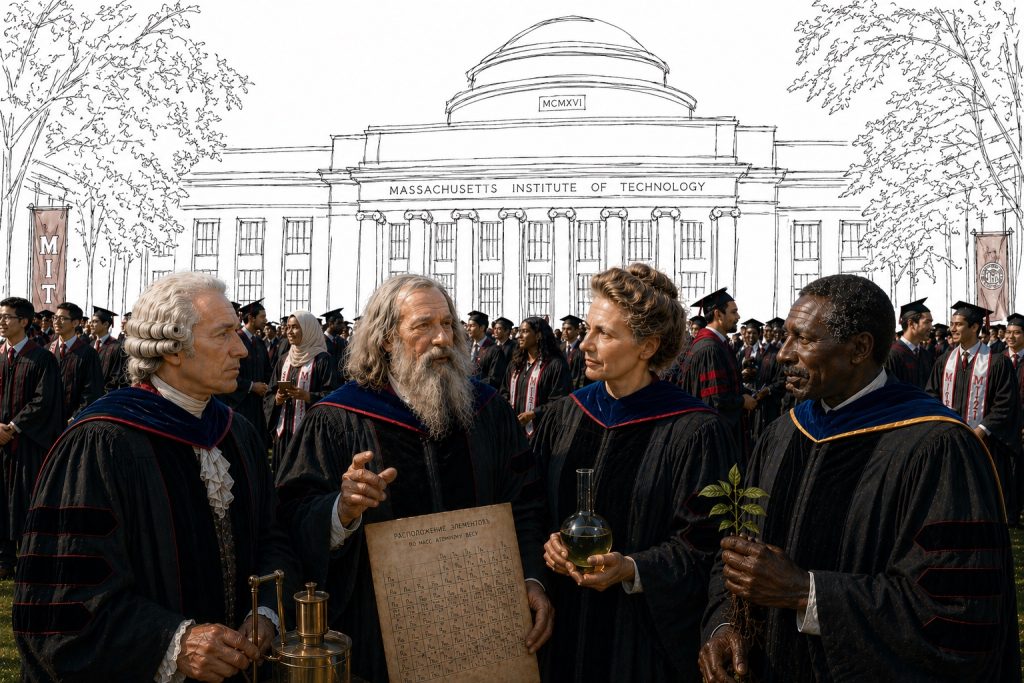
(from left to right, as remembered): Antoine-Laurent de Lavoisier (1743 in Paris, France – 1794 in Paris, France), Dmitri Mendeleev (1834 in Tobolsk, Russia – 1907 in Saint Petersburg, Russia), Marie Curie (1867 in Warsaw, Poland – 1934 in Passy, France), George Washington Carver (c. 1864 in Diamond, Missouri – 1943 in Tuskegee, Alabama)
(Image created with ChatGPT.)
The scientists who left Germany in the 1930s arrived without ceremony. They came as displaced people – von Neumann, Bethe, Fermi, among many others – rebuilding their work in institutions that could absorb it. American universities did not inherit a lineage; they became one because others were forced to leave theirs.
The movement of talent is structural to science.
Structures, once stable, reverse.
Look again at the court.
In a few weeks, the Class of 2026 will cross this lawn. Among them are students who came from elsewhere and, for a time, made this place their intellectual home. Some will leave without choice – not for lack of ability or intent, but because the system that trained them provides no mechanism to keep them, redirecting them by rules that sit entirely outside the work they have done.
The scale differs. The mechanism remains familiar: a system that trains talent and then, quietly, directs it elsewhere.
Mendeleev stands above Lavoisier – on Building 4 – inscribed as Mendelejeff, an earlier Russian transliteration. The periodic table, first set down in the 1860s, invited revision and absorbed correction as new elements were discovered. It encoded a principle: that knowledge advances through the capacity to change itself over time.
Some decades later, under Lysenko in the Soviet Union of the 1930s and 1940s, that capacity was deliberately constrained. Established genetic theory was rejected on ideological grounds, and dissenting scientists were removed from their posts. Biology continued, yet its ability to correct itself was constrained by decree.
That is the failure that matters – the loss of a system able to correct its own course.
Look again at the names.
They mark discovery. They also mark a system that permits error and absorbs correction.
Students in the Class of 2026 understand that science advances through error, in spaces where one is allowed to belong, an insight reached between a failed experiment and a looming deadline.
The present offers familiar pressures: politics, law, public scrutiny. Recent legal decisions have narrowed the space in which institutions define their own commitments. The internal response has taken a quieter form. Decisions move through compliance structures, risk frameworks, and procedural review. Austerity sharpens the filter. What cannot be justified in advance does not begin; proposals are rewritten before submission, and questions are set aside when they cannot survive the process intact.
Diversity, equity, and inclusion – once articulated as commitments – now move through the same structures. They are defined and evaluated in advance, shaped by the need to align with constraints that are no longer internally set. Their presence remains; their condition of possibility changes – the space in which they can be pursued is reduced before the work begins.
The change becomes visible here, in what takes shape and what does not.
From the outside, the system appears adaptive. From within, it feels more limited.
The risk is not that knowledge disappears, but that the conditions that allow it to question itself contract – quietly, and in advance.
A university earns its autonomy by protecting work that does not yet know what it is for. Its role in moments of change lies in holding open a space where ideas can form before they are translated into utility, compliance, or alignment.
History offers a consistent record. Knowledge continues. Universities persist. The form remains while direction shifts. Fields contract, migrate, or stall. Recovery, when it comes, unfolds over decades and often in different places.
We have reached the edge of the court.
The names remain fixed above us. They mark achievement. They also mark the continuity of systems that, at critical moments, either preserved or surrendered the conditions that made such achievement possible.
In a few weeks, another set of names will be called on this lawn, one by one, before dispersing again, with a logistical precision that would have impressed Lavoisier.
Late April holds that uncertainty. Names are read aloud before they are fixed into trajectories, before a system decides what it will permit to take form and what it will quietly direct elsewhere.
The names in stone do not change.
Those spoken here will move outward into systems not yet fixed.
What they make of those systems will.