

In the fall of 1987, released from teaching by a Guggenheim Fellowship and invited to China to lecture as an American feminist intellectual, I visited there for two months, lecturing in six eastern cities: Beijing, Xuzhou, Hefei, Shanghai, Hangzhou, and Guilin. I spoke about American women’s history and the history of feminism, feminist literary criticism, contemporary women’s writing (especially Black women’s writing), and women’s issues more generally, such as salary discrepancy, harassment, daycare, and eating disorders. This last issue shocked my Chinese audiences the most! Since I knew no Chinese, I prepared for my journey by reading every Chinese story and novel I could find that had been translated into English, so that I would have some common ground with my interlocutors. Many were my adventures in that large and various country.
I explored the imperial palaces in Beijing, discussing the “cultural revolution” with people who had lived through it, those who had suffered and a few who had met their partners in the countryside and remembered this traumatic period as a romantic and idealistic time[1]. I saw the beautiful gardens of Suzhou and the lovely Yangtse River in Guilin and also that city’s huge underground caverns, with great accretions pushing up from the floor and hanging from the ceilings, gigantic and creased and indented like brain tissue or lapped over like cloth from a giant’s bolt. I remember arguing about subjectivity with a poet in Guilin, who told me that the best poems were simply more accurate to the phenomena they described than lesser poems – and that what I attributed to “subjectivity” was merely a matter of inaccuracy. I remember trying to describe psychoanalytic criticism to another literary critic as we rowed a boat on the famous West Lake in Hangzhao, taking my examples from short stories I had read in translation. I climbed the famous Huang Chan, the Yellow Mountain, in Anhui province, terrified most of the way because the path was so steep and perilous, often just shallow footholds cut into the rock, without anything to hold onto. The worst moment came when crossing a narrow arch of stone without guardrails in a high wind with a sheer fall to certain death on either side.
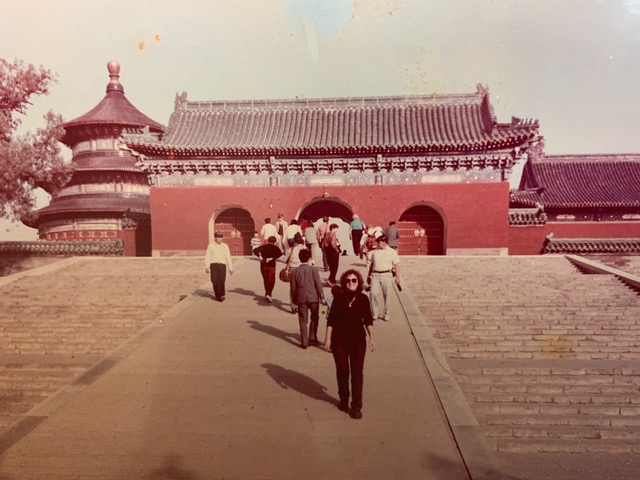
Everywhere I spoke I had to contradict the assumption that “women’s liberation” was about sexual license, which I told them was a male fantasy. One woman told me that older men, 50 years or older, were more tolerant of feminism and more egalitarian in their relationships, because traditional masculinity in China had been more “feminine;” i.e., the ideal man was gentle, civilized, learned, helpful, thoughtful, and generous. But, she said, younger men were more arrogant towards women, aggressive and even rude, because they were imitating Western men in what is considered “manly.” She said that the younger generation at that time thought everything “Western” was better.
When asked for the current political slogans about men and women and feminism, I was hard put to come up with any. We did not “do” slogans the way the Chinese did, I tried to explain. But then I thought of “The personal is political” and explained that, in the context of women’s consciousness-raising groups, women were seeing that problems they had thought were personal were, in fact, part of the misogyny of the culture.
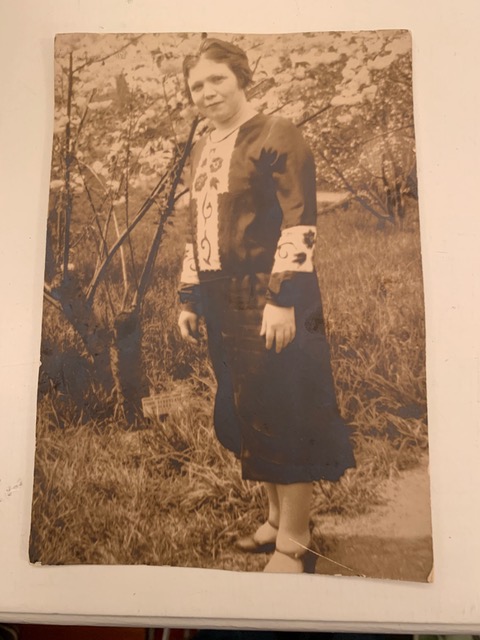
But one of my most precious memories from that trip came when I spoke to the Women’s Cadre College in Beijing. I had been invited to talk about the history of women’s rights in the US, not something I had ever studied or worked on, but I knew where to look. Much of my lecture came straight out of Eleanor Flexner’s Century of Struggle: The Woman’s Rights Movement in the United States (1959). And before I began, I gave my real credentials for the talk – not my position at MIT or the books and papers I had published on women and gender in literature and history. I told them about my grandmother. She had been the first steward of her shop for the International Ladies Garment Workers Union, the ILGWU[2], and her daughter, my mother, had been on the picket line strapped to her back before my mother could even walk. With a roar, the audience broke into spontaneous loud applause, which lasted quite a long time. It was something to stand surrounded by this unprompted tribute, and to register their appreciation of the facts as I had heard them from my mother. I had always been proud of this history but had never mentioned it in public before. It had never seemed relevant. But here was this large hall of women from the other side of the globe clapping for my grandmother’s dedication to her union. It was heartwarming at the time, and has stayed with me down the years as one of the high points of my memorable China trip.
[1] China in 1987
Mao Tse-Tung died in 1976, and with him the “cultural revolution.” Deng Xiaoping succeeded him, opening up the Chinese economy to Western market capitalism, which is why speakers like me were encouraged to come to China. But Deng also ordered the crackdown in Tiananmen Square in 1989: Western concepts of free speech were one thing, but putting them into practice quite another. 1987, when I lectured there, was a time when the interest in Western political ideas was encouraged, but their actual local practice was still frowned upon.
[2] ILGWU
The ILGWU (International Ladies Garment Workers Union) was founded as early as 1900, and grew by leaps and bounds, especially after the 1911Triangle Shirtwaist Fire, in which 150 young women were burned to death or leaped to their deaths because the doors of the factory had been locked to prevent them from taking breaks. The tragedy became a cause célèbre, and 100,000 people attended the victims’ funeral. My grandmother, an immigrant seamstress, joined the ILGWU a few years later, in 1913, and was elected the steward of her shop.