

The paradigmatic instructor in Indian legend is the guru Drona. Renowned for his ascetic ways and his skill with weapons of all sorts, Drona is tutor to the competing clans of princes whose story is told in the Sanskrit epic called the Mahabharata. In a famous episode, Drona offers an archery lesson to the young princes. The target is a bird-shaped dummy perched in a tree. One by one, the students step up and take aim, but before each boy lets his arrow fly, Drona asks a question: “What do you see?” Each answers in turn, “I see the bird, the branch, the leaves and the tree, the earth below, the sky, the sun, and the clouds.” Each shoots – and misses! Until it is the turn of prince Arjuna. “What do you see?” Drona asks him. Arjuna replies, “The bird. Only the bird.” His is the one arrow that hits the target, setting him on a trajectory to become the greatest warrior in the world.
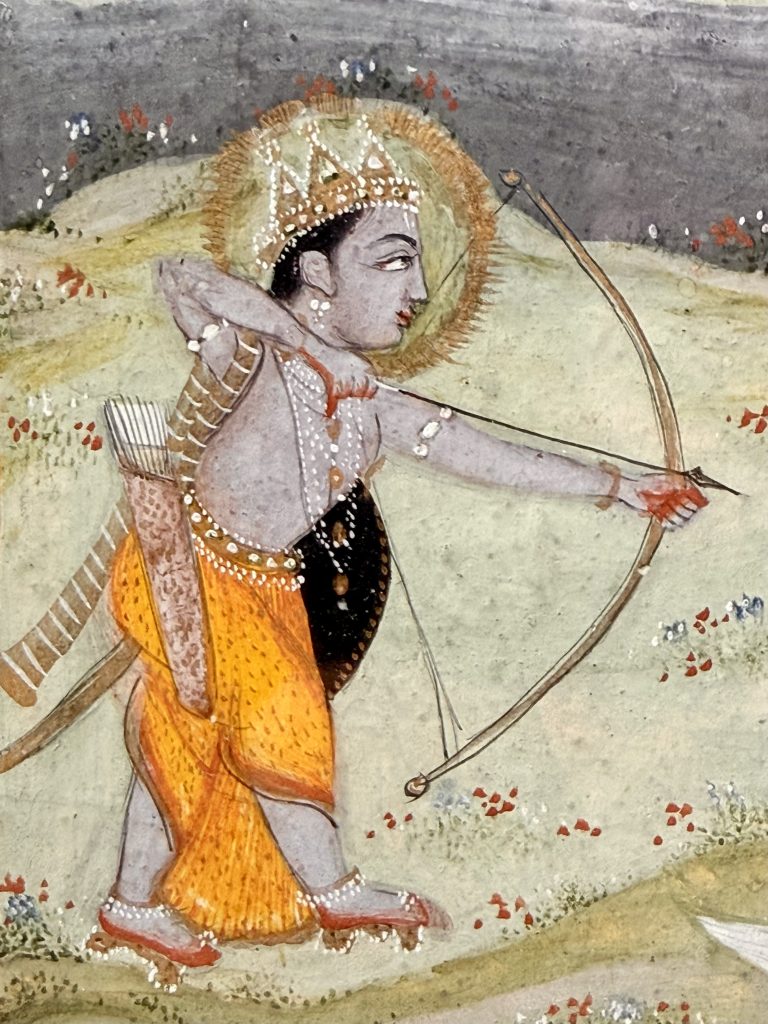
Artwork a selection from the author’s private collection.
Drona’s teaching about the necessity of focus is one we can relate to at MIT. We select trainees for dedication and persistence in goal-driven activities, beginning with the art of gaining admission in the first place. Compared with earlier generations, the top US college recruits of today spend much more effort purposefully building their resumes, fueling an ever-growing industry of preparation services[1], as well as countless summer and afterschool programs. Because of our reputation, we intrinsically attract students with the wherewithal to succeed in demanding STEM areas. They work harder than pupils at almost every other US institution[2], drinking heavily from the firehose of an MIT education. They also play hard, frequently choosing to spend their spare time in the more than 100 campus clubs devoted to educational, preprofessional, or technology-related topics[3]. Even the dating scene at MIT is science-oriented: “carbon-14 is the usual method,” as the joke goes[4]. And when viewed as a group, our students are yet more focused than they are as individuals; they aim their arrows preferentially at a subset of the academic targets we offer, with more than half of upperclassmen here majoring in just two of the 21 active course numbers[5].
Staying focused brings rewards. This lesson has been popularized by media figures like Malcolm Gladwell, with his “10,000 hour rule” – the principle that solid effort over the equivalent of several years is what it takes to excel in a field of endeavor[6]. The stereotypical successful inventor or innovator is in fact a person who remains fixated on the task at hand, to the exclusion of all else. Thomas Edison taught us that perspiration is the key to realizing creative genius, and he was famous for his extreme work habits. In describing Demis Hassabis, the AI pioneer and former MIT postdoc who may be one of the Edisons of our time, a colleague remarked[7], “There is no 50% mode in Demis. There is not even a 99% mode in Demis. There is only 100%.” Alumni of MIT in general are able to leverage their extraordinary work ethic and rigorous training to get better paying jobs than graduates of other top universities[8]. Their industriousness contributes to the economic heft of MIT spinoffs that collectively net trillions of dollars in annual revenue[9].
We as faculty are surely conscious of how important the ability to concentrate and compartmentalize is to our own careers, but who among us has not also realized that extreme dedication comes with a penalty? Most immediately, there is always an “opportunity cost” when commitment to one goal crowds out other business or pleasure. The trade-off between work and family is particularly challenging for many, exemplified by the statistic that academics tend to delay parenthood by years compared with the general population, with greater effects among female faculty[10]. Over a century ago, Marie Curie delayed motherhood by the standards of fin-de-siècle France, but the greatest personal cost of her relentless quest to understand radioactive materials was her own death by presumed radiation poisoning. Professor Curie’s story is a reminder that the unintended consequences of single-minded professional focus can be dire indeed.
Narrow focus can also obstruct progress on a larger scale. In Thomas Kuhn’s celebrated portrayal of scientific history[11], “revolutions” are required largely because scientists tend to cling to fixed ways of viewing the natural universe; the old guard literally needs to die off in order for better ideas take hold. Blinkered attitudes in science and engineering can have major implications for society. For instance, the journalist Charles Piller has argued that allegiance to a longstanding biological hypothesis may be partly to blame for hindering advances in Alzheimer’s research[12]. In the recent past, the destructiveness of the Covid pandemic and its divisive reverberations might have been mitigated if policymakers had better balanced a variety of societal concerns, rather than prioritizing a strictly epidemiological view. And in our newspapers today, we can see the unwillingness of Silicon Valley to grapple with the negative effects of social media on mental health and the spread of misinformation, even though these externalities arise almost inevitably from core functions of the platforms. In all of these cases, more open-mindedness and less adherence to specific conceptual or commercial commitments could have led to better outcomes.
Each of us has a duty to use our gifts for the greater good. In the ancient vocabulary of the Mahabharata, this is our dharma as scholars. It also parallels the mission of our Institute, “to develop in each member of the MIT community the ability and passion to work wisely, creatively, and effectively for the betterment of humankind.” In today’s circumstances, the betterment of humanity depends increasingly on integrating science and engineering into the public sphere. To play a productive part in this synthesis, we cannot remain too fixated only on our technical goals, let alone on the financial rewards they could bring. We need to think broadly about how the ideas and innovations we work on will improve lives for people in a multidimensional world. Importantly, we must also be ambassadors for science and academia in general, doing our part to ensure that advances in knowledge translate into advances in public understanding and appreciation for the value of research itself.
The novelist Vikram Chandra provides an apt metaphor by flipping the script on Drona’s original archery lesson[13]. In Chandra’s reimagined version, it is Arjuna’s lesser brothers who see only the bird, while Arjuna himself sees both the bird and its surroundings. His arrow is still the only one that flies true, but it is now guided by a fully informed view, rather than by tunnel vision. As we send our graduating students on their way, let us encourage them to be like this modern Arjuna – still aiming for the target, but engaged always with the environment around them.
[1] https://navagant.com/wp-content/uploads/2024/09/Education-Consulting-Industry-Report_Aug-2024.pdf
[3] https://engage.mit.edu/club_signup
[4] https://www.reddit.com/r/Jokes/comments/1q1lp1/whats_the_dating_scene_like_at_mit
[5] https://registrar.mit.edu/stats-reports/majors-count
[6] Gadwell, Malcolm. Outliers: The Story of Success. Little, Brown, & Co., 2008.
[7] Mallaby, Sebastian. The Infinity Machine: Demis Hassabis, DeepMind, and the Quest for Superintelligence. Penguin, 2026.
[8] https://www.statista.com/statistics/244473/top-us-colleges-by-starting-and-mid-career-pay-of-graduates/
[9] https://news.mit.edu/2015/report-entrepreneurial-impact-1209
[10] https://www.science.org/doi/10.1126/sciadv.abd1996
[11] Kuhn, Thomas. The Structure of Scientific Revolutions. University of Chicago Press, 1962.
[12] Piller, Charles. Doctored: Fraud, Arrogance, and Tragedy in the Quest to Cure Alzheimer’s. Atria/One Signal, 2025.
[13] Chandra, Vikram. Red Earth and Pouring Rain. Little, Brown, & Co., 1997.