

Where Does Civilitas Live? Wikipedia, MIT, and the Infrastructure of Equity
Amy CarletonThis spring I received two invitations that turned out to be about the same question. The first was to write for this graduation issue of the Faculty Newsletter. The second was to present at Wikimania 2026, the annual global conference of the Wikimedia movement, taking place this July in Paris. The conference theme is Liberté, Équité, Fiabilité, or Freedom, Equity, Reliability. “Together,” the organizers write, “let’s protect knowledge, equity, and freedom.”
I study Wikipedia. More specifically, I study how Wikipedia works as a democratic experiment – how strangers on the internet, who may disagree on nearly everything else, manage to build something both rigorous and reliable because they share a commitment to making knowledge freely available. This has been my research for years, and it has given me a particular lens on a question MIT is now navigating in real time: when institutional structures around equity are reorganized, what endures and what evaporates?
Two Letters, Five Years Apart
Two letters, separated by five years, mark the arc of a significant institutional shift. In July 2020, then President L. Rafael Reif wrote to the MIT community describing ‘a historic opportunity to accelerate the transition to a more just and equitable future.’ The letter addressed the challenge through four lenses: collective responsibility, systemic strategy, community solidarity, and confronting MIT’s own history. Among its most concrete commitments was a comprehensive strategic action plan for diversity, equity, and inclusion, with new investments, dedicated senior leadership, and centralized coordination through the Institute Community and Equity Office (ICEO).
In May 2025, a different letter was sent to the MIT community. It was noted that a working group had found that while the community valued the ICEO’s programs and remained committed to inclusive excellence, there was “a broad desire to rethink how this work is done in practice.” The common refrain: “community is best built locally rather than top down.” The central ICEO would be sunset. The office’s programs, including the MLK Visiting Scholars program, the Community Learning Initiative, Random Acts of Kindness Week, would be distributed across other units: the Vice Provost for Faculty, the Division of Student Life, Human Resources.
MIT’s administration has said this decision was unrelated to the current White House administration’s derision toward DEI in higher education or to MIT’s status among colleges investigated for potential Title VI violations. I take that claim at face value. But I also note the landscape: in the same period, many other institutions closed or renamed their DEI offices. More recently, MIT’s own fifty-year-old Office of Minority Education was folded into a broader advising structure as the new Office of Academic Community, Empowerment, and Success. Whatever the internal rationale, these changes are happening inside an environment of unmistakable external pressure – federal funding uncertainty, proposed research cuts, and an administration that has made opposition to DEI a stated policy priority.
The question I want to ask is not whether the old model was perfect or the new model is wrong. It is a more genuinely difficult question: What does distributed equity work actually look like in practice? And here, my research gives me something concrete to offer.
What Wikipedia Teaches Us About Distributed Models
Wikipedia is, in many ways, the world’s longest-running experiment in distributed equity. There is no central DEI office. There never has been. Equity work happens through volunteer-driven projects, community norms, talk-page discussions, and infrastructure choices made by editors who will never meet in person. The Wikimedia Foundation provides technical infrastructure and some programmatic support, but it does not dictate editorial content or community governance. The model is radically decentralized.
And it has produced something extraordinary. Wikipedia turned 25 this year. It remains one of the most visited websites on earth, available in over 300 languages, built entirely by volunteers, free to anyone with an internet connection. In his recent book, The Seven Rules of Trust: A Blueprint for Building Things That Last, Wikipedia co-founder Jimmy Wales argues that when people are united by a shared purpose and equipped with clear principles, collective intelligence can triumph over individual expertise. Wikipedia has demonstrated that this is possible.
But – and this is an important part to note – Wikipedia’s distributed model has also produced well-documented equity failures. The gender gap among editors is persistent and severe. Coverage of the Global South remains thin. Sourcing biases systematically favor English-language, Western, and institutional perspectives. The community has been working on these problems for over a decade, and progress has been real but slow. The Wikimania conference in Paris is organized, in part, around the frank acknowledgment that the world “has never been so dangerous for the free encyclopedia and its entire ecosystem.”
What my work suggests is that distributed models have genuine strengths (resilience, grassroots ownership, authentic peer-to-peer accountability, to name a few) but they do not self-correct automatically. Equity in a distributed system requires what I would call intentional infrastructure: shared norms that are genuinely internalized rather than merely posted on a website; visible feedback loops that reward equity work; low-barrier pathways for newcomers to participate; and someone – even if it’s not a central office – tracking whether the system is actually producing equitable outcomes. Without that intentional infrastructure, “distributed” risks becoming a polite word for “nobody’s job.”
Civilitas and the Civic Arts
In a lecture I gave at the MIT Libraries earlier this year on Wikipedia’s 25th birthday, I argued that Wikipedia embodies something the classical tradition called civilitas – not civility in the modern, diluted sense of mere politeness, but the original Renaissance and Roman meaning: the speech and behavior of people who treat each other as equals, who deliberate together about shared concerns, who understand that self-governance is a practiced art requiring cultivation and study.
Consider one of Wikipedia’s most distinctive practices: the “barnstar.” When editors want to recognize a colleague’s contribution – resolving a difficult dispute, improving a contentious article, patiently mentoring a newcomer – they award a virtual barnstar on that editor’s user page. The name evokes the American tradition of barn-raising: neighbors coming together to build something larger than any individual could construct alone. It is a deliberate (and very legible!) metaphor of collaborative construction rather than destructive conflict – barn-raising as opposed to barn-burning.
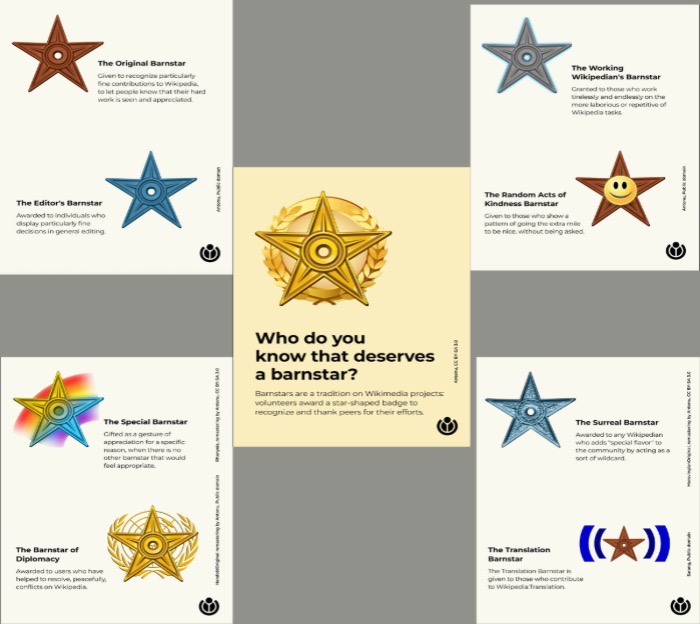
The barnstar represents exactly what civilitas requires: recognition that we build knowledge together, that individual contributions matter, and that the work of creating shared understanding deserves honor.
This culture pervades Wikipedia’s daily operations. On talk pages, editors with different viewpoints must engage with one another as equals. They must explain their reasoning, respond to objections, and work toward language that reflects the weight of reliable sources rather than personal preferences. They cannot simply assert authority or dismiss disagreement. They must marshal evidence, appeal to shared principles, and treat other editors as worthy collaborators – even when they disagree profoundly.
These are not grand gestures – rather, they are precisely the habits of mind and heart that self-governance demands. Every Wikipedia article represents thousands of small acts of civilitas: someone noticed an error and fixed it; someone found a better source; someone accepted that their preferred phrasing wasn’t neutral; someone compromised or arrived at consensus.
The question is whether those habits can survive without cultivation. And the answer, from Wikipedia’s own experience, is: not reliably. The communities within Wikipedia where equity work thrives are the ones where someone is actively tending to it – organizing edit-a-thons, mentoring newcomers from underrepresented groups, maintaining WikiProjects focused on coverage gaps. Where no one tends to it, the defaults reassert themselves. The barn doesn’t raise itself.
The Question for MIT
I do not presume to know the right organizational chart for equity work at MIT. Reasonable people can disagree about whether centralized offices become bureaucratic, whether distributed models are more authentic, or whether the answer lies somewhere in between. These are legitimate questions of institutional design.
But my research compels me to ask a few questions that I think deserve honest answers as MIT moves forward.
First: Who is tracking outcomes? In Wikipedia’s distributed model, the Wikimedia Foundation still collects and publishes data on editor demographics, content coverage gaps, and participation trends. Without that function, the community would have no way to know whether its equity commitments were translating into equitable results. As MIT distributes the ICEO’s work across multiple units, who holds the bird’s-eye view? A Standing Institute Committee has been established, but committees are advisory. The question is whether anyone is accountable for equity outcomes – not as a compliance matter, but as a measure of institutional health.
Second: What happens to the connective tissue? One of the subtler functions of a central office is convening – creating the space where people doing equity work in different parts of the institution can learn from each other, share resources, and build solidarity. MIT is a famously decentralized place; departments and labs operate with enormous autonomy. That autonomy is a strength for research. Whether it is a strength for community-building is a different question. The working group that recommended the ICEO’s closure also recommended “some mechanism for the people doing this work to collaborate easily.” The gap between recommending a mechanism and building one that actually functions is where institutional intentions often quietly expire.
Third: What message does structure send? Organizational structure is not just a management question. It is a signal about what an institution values enough to invest in visibly. The creation of a vice president role in 2020 sent one signal. The sunset of that role in 2025 sends another. Both signals are visible – or to use Wikipedia parlance, on “mainspace” – for prospective students, to faculty candidates, and to the broader community…including the graduates reading this issue.
To the Class of 2026
You are entering a world where the infrastructure around equity is being renegotiated everywhere – in technology companies, in government, in universities, and on the platforms where knowledge itself is produced. This is not abstract. It is the world you will build careers in, raise families in, and exercise citizenship in.
The question is not whether equity matters. Wikipedia’s global community is staking its twenty-fifth anniversary on it. President Kornbluth describes the Institute as dependent on talent of every background. Even the fiercest critics of DEI bureaucracy rarely argue that institutions should stop caring about who is included and who is left out. The question is who holds this work, how, and with what resources.
What Wikipedia’s twenty-five-year experiment has taught me is that the art of building knowledge together across difference – what I have called civilitas – requires formation. It requires practice. It requires infrastructure (however lightweight) that someone is actively maintaining. The barnstars don’t award themselves. The barn-raisings don’t organize themselves. The civic arts require cultivation. That was true for the Romans, it was true for the American founders, and it is true for us.
As you leave MIT, carry this with you: that the habits of civilitas – reading carefully, thinking critically, engaging respectfully with those who disagree, distinguishing evidence from assertion, building rather than burning – are not just nice to have. They are the preconditions of every institution you will ever depend on. And they are always, always someone’s responsibility to tend. Having worked with or alongside many of you for the last four years of your journey, I know with great certainty that you are up for the challenge – and that you understand, as this place has always insisted, that mind without hand builds nothing.