

Our Ecosystem Under Duress: An Invitation to Engage
The Editorial Board of the MIT Faculty NewsletterMIT’s ecosystem of research and teaching was established over generations by individuals drawn to this institution from around the world by the promise of academic freedom, resources, intellectual exchange, and institutional support. This ecosystem has served our community, the nation, and the world exceptionally well. It has created new fields, launched companies, trained generations of leaders, and produced ideas and technologies that society could not have anticipated.
Yet many now sense that this ecosystem is under increasing stress. The pressures we face do not arise from a single policy, administration, or external event. They reflect the convergence of forces both inside and outside MIT. If MIT is to remain a globally leading research university, we need to speak plainly about these challenges and address them with seriousness and creativity. The Faculty Newsletter can help analyze and address these concerns, broaden awareness, and encourage constructive engagement. Based on informal input from colleagues across MIT, statements from the Institute’s leadership, and our own observations, we believe that several outstanding challenges deserve our collective attention.
The first challenge is access to global talent. Across all fields, MIT’s excellence depends on attracting students, postdocs, staff, and faculty from around the world. We have constantly assessed and reassessed the meaning of the meritocratic criteria we seek to apply when embracing new colleagues and trainees. At the same time, national immigration policies, rising geopolitical tensions, and a perception that suspicion and fear have begun to displace opportunity and trust, are making recruitment and retention more difficult. Prominent faculty have even chosen to leave MIT for positions abroad. The lack of clear pathways to support the retention of global research talent compounds the problem.
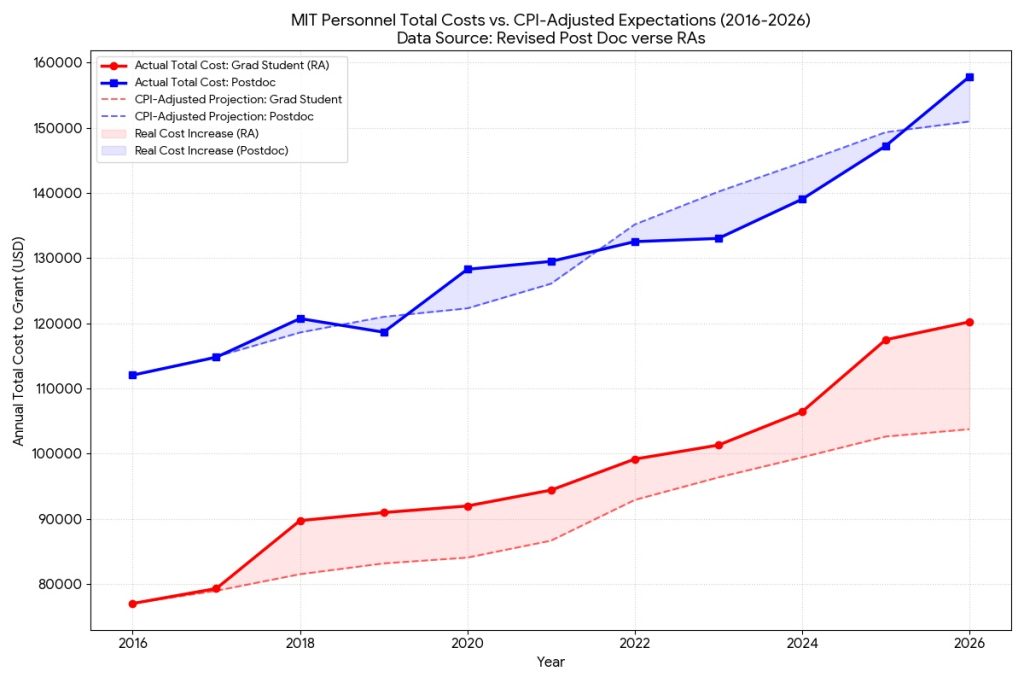
The second challenge is cost. The cost of graduate students and postdocs, the lifeblood of MIT, has increased by about 50% over the past 10 years alone well in excess of the inflation (see graph), while funding resources have failed to keep up. An inability to support as many students harms the research and teaching missions of every department and School at MIT. In experimental research, personnel costs are only the beginning: equipment, maintenance contracts, shared facilities, specialized staff, data infrastructure, and lab renovations all add substantial expense. Renovation costs now reaching thousands of dollars per square foot threaten the ability to launch junior faculty labs or adapt existing ones to new research needs. The new 8% endowment tax substantially reduces MIT’s flexibility to meet these needs. At the same time, administrative staff growth raises difficult questions about the underlying reasons for some of the cost escalations, which may be unintended but are still an onerous collateral of MIT’s financial model. Our higher costs can sometimes make our proposals less competitive dollar for dollar when compared with other research institutions.
The third challenge is federal funding for research. MIT’s research infrastructure was shaped by the postwar partnership between universities and the federal government. That partnership enabled discoveries whose benefits often emerged decades later and yet its existence and value are now called into question. Through training grants and project-focused awards, the federal government has been MIT’s first and foremost patron. It is now actively questioning the return on its investments and is certainly in the midst of shifting its priorities from PI-led research to larger efforts, such as the Department of Energy’s Genesis Mission, that some say prioritize industry and national labs. Beneficiaries that become adversarial to their sponsors suffer significant consequences; to avoid this situation, we may need to rethink our approach to federal engagement if we are to prosper through shifting environments.
A fourth challenge is diminishing public confidence. This issue was elegantly analyzed in the recent Yale Report of the Committee on Trust in Higher Education, which concluded that “the issue of declining trust is real, urgent, and must be addressed.” Universities have long benefited from the widespread belief that higher education and research serve the common good. That trust has weakened. Some of this reflects broader polarization and skepticism toward institutions and towards the scientific enterprise, and some also reflects universities’ failure to explain themselves clearly and form bridges to the broader public. The public hears about large endowments, high tuition, controversial campus politics, and administrative expansion, but strains to understand the connection between research and education at MIT and the national interest – i.e., how federal funding becomes new knowledge, therapies, industries, national security capabilities, environmental tools, and trained people. One needs to focus on fixing the former while improving the latter.
Finally, we must look inward at our own culture. MIT has extraordinary strengths, but we are not free of faults. The status of academic freedoms on campus has been challenged from multiple directions. Sentiments expressed by a considerable fraction of MIT’s faculty regarding self-censorship and free expression reflect some of the community-wide tensions we face at present. Emergence of the student union represents another material change to our culture, which could benefit from further reflection and analysis. Interactions between the faculty and the administration have also been distant at times, leading to misunderstandings about policies and occasional missteps. As befits an institution devoted to learning, we must constantly evaluate our own performance as a community, acknowledging mistakes where appropriate and learning from them where possible.
The Faculty Newsletter aims to strengthen MIT-wide discussion of the challenges that face us all, in an open and productive way. With refreshed editorial leadership and improved policies and procedures soon to be adopted in the wake of the recent Silbey report, the FNL can become an even more consequential forum for addressing pressing Institute-wide challenges. In coming issues, we hope these pages will help the community examine, deconstruct, and mitigate the pressures facing MIT’s research and teaching ecosystem. We invite colleagues with insight and concerns to share their perspectives on how MIT can remain resilient, dynamic, and worthy of the talent it seeks to attract.