

We came out of Denver, the Mile High City, at 5,280 feet above sea level, where the air is thin and the light falls clean and hard off the Front Range in a way that makes everything look slightly more permanent than it is. My father had settled there after the war, after service in the medical corps tied to the return of wounded men, through the Fitzsimons General Hospital in Denver (the largest medical hospital in the world) east of the city, received them. My father stayed on after discharge, as though the altitude itself had decided something for him. We did not move again. I was born there in 1950, into a city that still carried the discipline of the frontier – wide skies, thin air, and the habit of not speaking directly about the things that might undo you.
But every summer, that world loosened its grip.
A good stretch of my boyhood belonged to Brownsville, Louisiana – every summer of my childhood, in the years including the Supreme Court’s ruling (Brown vs. Board of Education) and the Civil Rights Act, when the country was deciding something about itself and had not finished deciding yet. Brownsville sat in Caldwell Parish in the north-central part of the state, a small, predominantly Black community near Columbia, the parish seat, which perched along the slow green curve of the Ouachita River. It was where my people were from. Extended family fanned out across that land – aunts, uncles, cousins, grandparents – and the summers I spent there shaped me as surely as the streets of Denver did, maybe more. The two places could not have felt more different to a boy with energy that had nowhere to go. And yet they were bound together by blood and by the long, unfinished story of why Black families like mine had made that journey West in the first place.
More than a thousand miles separated Denver from Brownsville, whether you went by road or rail, and every mile was a kind of instruction. As a kid you didn’t always recognize what you were being taught. But the way the adults prepared for those trips – the careful routing, the food packed the night before, the conversations that dropped to a murmur when they brushed certain edges – told you that this was something more than a summer visit. Getting from Denver to north Louisiana required knowledge, timing, and a steady quiet courage the adults around you wore so naturally you didn’t recognize it as courage. Almost.
The Car
We had one family car in Denver, and in the summer it ceased to belong to the city and became a vessel of return. Uncle Robert drove. He was the youngest of my mother’s 10 siblings, the tall one – well over six feet – who had to fold himself into the front seat with his knees angled and his shoulders turned slightly inward, as though the car had been built for a smaller version of the life he contained. He carried something of the South in him still, and something restless alongside it, something already leaning past what the South had tried to make him.
My father could drive. I know that. But he did not take the wheel on those trips south. There was something unspoken in his story – something about ambulances and speed, about the cargo of men who did not always arrive alive. Whatever it was, he kept his hands off that particular road. So it was Uncle Robert who drove, and we who followed, with enough people to rotate through the miles, enough watchfulness distributed among the adults to carry us all the way through. And my mother was the backup driver.
The car was packed the night before every trip. Not just luggage – a full cooler of food. Fried chicken wrapped in wax paper, still warm from the night before. Boiled eggs. Sweet potato pie. Biscuits that had been baked that morning. You didn’t pack a cooler because you were hungry. You packed it because you could not be certain, once you left Colorado, that you could walk into a roadside diner in Kansas or Oklahoma or Texas and be served with anything resembling dignity, or served at all.
There was a published guide called the Negro Motorist Green Book – a slim directory, updated annually, listing hotels and service stations and restaurants across the country where Black travelers were known to be welcome. Many families carried it like a second passport. Our family didn’t. What we carried was older: the accumulated intelligence of family, neighbors, and community. It moved by telephone, by kitchen table, by the back end of church parking lots. Which towns you moved through without stopping. Which stretches required that you clear before dark. Which stations had decent people behind the counter. That knowledge was ours.
There were thousands of sundown towns – places where, if you were Black and the sun was going down, you needed to be gone. You knew them. You fueled up where the welcome had been verified. You ate from what you’d brought. You planned every stop around what had already been tested.
For a boy who could barely sit still, the trip was its own territory. From Denver through the high plains and down into the Gulf South, the road taught harder lessons with every mile. No interstates in the early years – two-lane highways that took you straight through the middle of towns rather than around them, so you saw everything: the storefronts and the courthouse squares and the signs that told you without ambiguity what kind of place you were passing through. You watched the soil change from the pale, alkaline dust of the high plains to the deep red clay of Oklahoma to the sandy loam of north Louisiana, the land itself recording its own history in color and texture. You were in the South now. The rules had changed. The adults had been preparing you for this, quietly, since before you backed out of the driveway.
You noticed when your father’s jaw tightened going through certain towns. You noticed when the adults stopped talking, when the car went quiet rolling through a small Southern downtown at 30 miles an hour with the windows up in August heat, because that was the way it was done. And when you finally turned off the highway onto the red-dirt roads leading into Brownsville, and the dust rose behind the tires, and you could see the cousins already running toward the car from a hundred yards off – the exhale from the front seat was something a child felt in his body long before he could name what had been held.
We had made it.
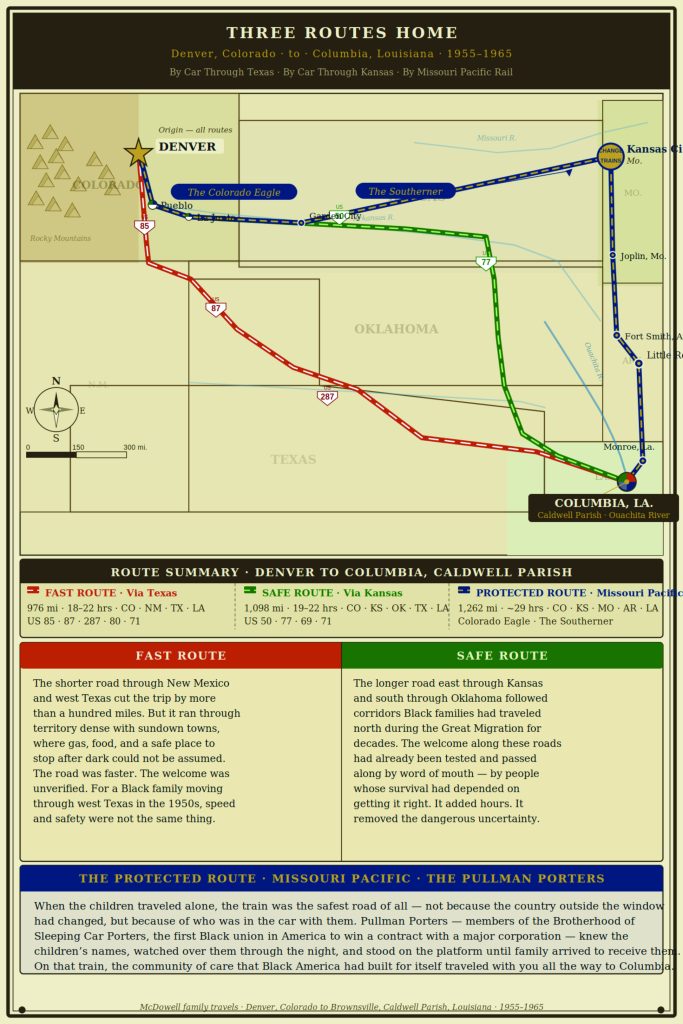
This map was produced using artificial intelligence, recording the travels of the McDowell family between Denver, Colorado and Brownsville, Caldwell Parish, Louisiana during 1955–1965. Route geography, highway designations, and mileages are drawn from historical road atlases and US highway records of the era. Railroad routing is based on Missouri Pacific Lines timetables and the documented history of the St. Louis, Iron Mountain, and Southern Railway. The narrative passages reflect the first-person recollections of a Black child born in Denver in 1950 who traveled these routes during the years recorded.
And then, in 1964, it stopped altogether.
I remember the day not because I understood it but because of where it interrupted us. We were in the living room watching Maverick on the black-and-white television – a Western, though not the solemn kind. This one played with the idea of the frontier, a gambler moving through it on wit and bluff, the sense that survival depended as much on reading a room as on drawing a gun. The hero was suspended between trick and fate, about to be hanged, when the telephone rang.
My father got up to answer it.
He stood there longer than he should have needed to. He did not speak much. When he came back, the room had changed, though nothing in it had moved.
Uncle Robert had been killed.
A Louisiana road somewhere outside of Arcadia. No details reached us. No account traveled beyond the family. One of those roads that does not enter the record, where something happens and folds back into the trees and is not required to be remembered by anyone except the people who loved the person it happened to.
He was 24 years old. After that, the car no longer made the trip south. But the South stayed. The same year, and in the face of potential violence by the Klan, Rev. Carter became the first Black man to pass the poll test and register to vote since 1906 in West Feliciana Parish. But Louisiana never forgot 1906, 1964, or 1965 – and in 2026, with the Supreme Court’s ruling in Louisiana v. Callais, the state became the instrument for dismantling the federal protections that had made Rev. Carter’s hard-won registration mean something beyond a single name on a single roll.
The driver was gone. The road had been held together by his presence – his height folded into the front seat, his hands on the wheel, his refusal to stop where stopping carried a cost. Without him, the journey had to break itself into different pieces.
My sister and I were also old enough to travel by train.
The Train
The Missouri Pacific Railroad laced itself across 11 states, its tracks running from the thin air of Colorado all the way to the humid Gulf Coast ports of Louisiana and Texas like a long dark thread stitching two different Americas together. Its fleet of Eagle trains was the architecture of that journey – boarded in Denver, transferred in Kansas City or St. Louis, then carried on south through the pine hills of Arkansas into Louisiana, where family would be at the Columbia depot to carry us the last stretch home to Brownsville. The better part of two days, with the whole country unreeling outside the glass, and the train rocking underneath you with a rhythm that felt, after a while, like your own pulse.
Sometimes we made that journey without the adults. A group of us, my sister and cousin – old enough to be trusted with the distance, young enough that the distance still felt like freedom – put on the train in Denver with tickets in our pockets, food in our bags, and instructions committed to memory and the certainty of the grown-ups that we would be looked after.
That assurance had a name and a uniform. The Pullman Porters.
The first Pullman Porters and Maids had begun working the sleeper cars around 1867, recruited by George Pullman almost entirely from the ranks of formerly enslaved Black men, many still carrying in their bodies the discipline forged by survival. By the time we were making those runs in the late 1950s, Pullman Porters and Maids were among the most respected figures in Black America – people who had traveled everywhere, seen everything, and belonged to something larger than the company that had tried to define them. What stood behind them had been built at enormous cost over 12 years of organized resistance: the Brotherhood of Sleeping Car Porters (BSCP).
On August 25, 1925, 500 members of the BSCP gathered in secret in a Harlem hall and chose A. Philip Randolph to lead them. Beside him, from the beginning, was Rosina Corrothers Tucker – who spent the next 12 years as International Secretary-Treasurer of the Ladies’ Auxiliary, traveling city to city, organizing the wives and families of porters, building the community networks that kept the movement from breaking when Pullman’s pressure was at its worst. Randolph did not work for Pullman, so Pullman could not fire him, and the company’s most reliable weapon was useless against him. The company fought with everything else it had: spies in the meetings, mass firings of known organizers, and at one point – reportedly – a blank check sent to Randolph’s desk, to be filled in for any amount up to one million dollars, in exchange for walking away. He sent it back.
The fight lasted 12 years. On August 25, 1937, a contract was signed: wages raised, hours reduced. The Brotherhood of Sleeping Car Porters and Maids became the first Black labor union to negotiate a collective bargaining agreement with a major corporation. It was, in the language of the era, a victory of Negro workers over a great industrial corporation. It was also, in the longer language of history, a rehearsal for what came after.
What that union built stretched well past the page of any contract. Pullman Porters and Maids were the nervous system of the civil rights movement before the movement had a name – carrying copies of the Chicago Defender from the North into barbershops and churches across the South, where its words arrived like contraband and were read until the paper fell apart. They reported lynchings to the NAACP. They carried in their heads the map of what the country actually was – the country as it showed itself when you crossed it with the wrong skin.
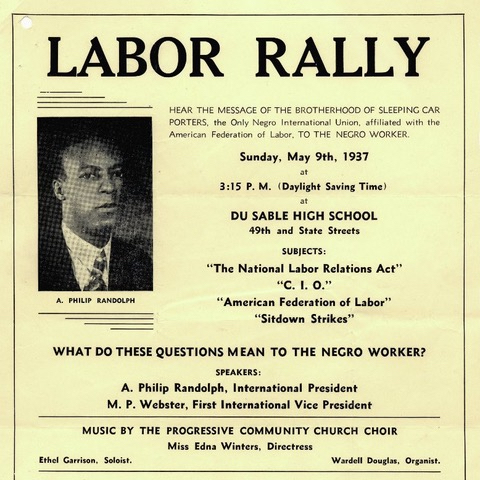
E.D. Nixon of Montgomery, Alabama, a Pullman Porter and Brotherhood leader, had spent decades organizing. When Rosa Parks was arrested, Nixon was ready. He arranged her bail. The union hall opened. The calls went out – to Abernathy, to the other ministers, to a young pastor named Martin Luther King Jr. who was new enough to the city that his name wasn’t yet famous – that summoned the movement into being. When a BSCP leader spoke, people in those communities listened with a particular attention, because a Porter had been to the places they hadn’t, and had come back.
None of that was abstract on the train. You felt it in how they moved through the car – deliberate, unhurried, possessing the space with quiet authority. They knew your name. They knew your stop. At night if something frightened you, deep into the Arkansas night, they were who you found.
One BSCP member remembered it this way: “I always catered to the kids. They’d come back to the club car and I would point out the scenery as we traveled. Their parents were appreciative that I had knowledge about where we were going.” That was exactly the shape of it. They turned the darkness outside the window into geography with names. That river bending south – that’s the Arkansas. Oklahoma’s behind us now; this here is Texas. Louisiana’s not far. They gave the journey a narrative you held on to.
The care we received from the Porters and Maids was etched from their character. Their “job,” however, was to tend to the white men, women, and children on board.
When the train finally slowed into Monroe and whichever Porter had kept watch over us walked us onto the platform – standing there until the family face appeared in the crowd, making the handoff certain before stepping back – that gesture required no translation. We had been carried through, and not merely by steel wheels on iron rails. We had been carried by members of the BSCP who understood precisely what it meant to move Black children safely across the American South in 1958, and who had, behind them, the weight of an organized movement to do it with something more than luck.
Brownsville: What the Summers Gave
The last miles from Columbia into Brownsville were their own country of arrival. The roads narrowed as if the land were slowly gathering itself inward. The trees pressed closer – pine and sweetgum and live oak wearing Spanish moss that hung like gray curtains from branches, a sight that did not exist in Colorado and never would, something between beautiful and mournful, depending on the hour and the light.
The first thing that hit you was the smell – not one smell but a whole conversation arriving at once: rich dark soil and something cooking inside the house and underneath all of it something wild and slightly rotten at the edge of the tree line, the smell of a place alive in a way Denver simply wasn’t. Then the cousins were on you before you’d fully straightened up, barefoot and loud, grabbing at your arms, and the summer cracked open like something that had been sealed shut all year waiting for exactly this moment.
Cooper’s was the first landmark that mattered to a 12-year-old – the only store, which meant the only place you might talk someone into a cold something and stand watching the world go by. But Cooper’s had a back room, and Friday and Saturday nights that back room became the most compelling place in the universe to a boy who wasn’t allowed inside it. You could hear it from the road – the crack of dominoes hitting the table, sharp and declarative, and underneath it the jukebox running its blues like a river under ice, and the laughter of men and women. You circled the building in the warm dark and stood near the door and listened, trying to absorb something just beyond your reach – the sound of men among themselves, at ease, in the only hours that fully belonged to them. Mrs. Cooper’s house was where you went when you were hungry in the way that had nothing to do with not having eaten – hungry for her red beans, cooked down since morning until they became something dense and dark and almost sweet, something with no equivalent in Colorado. You sat at her table and felt that this place was claiming you. That it recognized you even while you were still figuring it out.
There was a clock running in Brownsville that had nothing to do with any clock on a wall, and at 12 you felt it in the mornings when the older cousins were already gone. Gone – out of the house before I was fully conscious, into the blue-gray Louisiana dawn, heading to the cotton fields to hoe or pick before the heat made the work impossible. By noon the air above the rows was shimmering and my cousins came back with that slowness of people who had already spent what they had – clothes dark with sweat, carrying the morning in their posture. I watched from the porch and felt something between guilt and awe. These were kids barely older than me, kids I’d be chasing through the woods in two hours. I didn’t say anything about it. Nobody did. But I felt it as information that mattered – about where I’d been born, about what the summer required from each of us depending on that.
When the heat finally relented the woods pulled you in like they’d been waiting. Dense and bottomless, creek bottoms running under pine and hardwood. My cousins moved through those woods like they owned them because in the way that matters, they did. The woods charged a tax for admission and the tax was ticks. Coming out was as serious as going in – everybody stopped at the edge of the yard and checked everybody else, hands moving across legs and arms, thorough because missing one meant an adult finding it and the day going sideways. Standing still while your cousin’s fingers searched the back of your neck, doing the same for them – it sounds like nothing, but it was something. The first time in my life I understood what it felt like to be genuinely looked after by someone your own age.
My grandfather’s fire is the thing that lives deepest. He built it every evening after supper not for warmth but for smoke – his answer to the mosquitoes that arrived at dusk in genuine clouds, organized and sure of themselves. He kept a wet burlap sack beside the fire and at intervals laid it across the coals, the flame vanishing, white smoke spreading outward in every direction, the mosquitoes falling back. Then he’d uncover the fire, let it breathe, and wait. I sat across from him and felt the particular quality of sitting beside someone who knows exactly what they’re doing and has no need to explain it. Sometimes he talked about the land and people who had lived here before either of us could remember. Sometimes he said nothing, and the silence held more than the words would have. When the coals dropped low the lightning bugs came out in their hundreds and the night sounds changed register – frogs and cicadas taking over, the whole bayou humming a single long note underneath everything – and I was 12 years old with nowhere I had to be and nothing I had to do except sit across the fire from my grandfather and watch the smoke rise and feel that I was inside something very old that was also, somehow, mine.
The next afternoon there would be green beans to snap on the porch, everybody sitting together in whatever shade the yard offered, the older women talking and the younger ones listening or pretending not to, history moving from one set of hands to another through the sound of beans breaking clean, the bowl filling, the afternoon going slowly gold. There would be gardens to walk through – rows of collard greens and okra and sweet potatoes that the adults tended like the serious business they were, food grown from soil that belonged to the people growing it, and a pride in that which I could feel even if I was years away from understanding why it mattered so much that it be theirs.
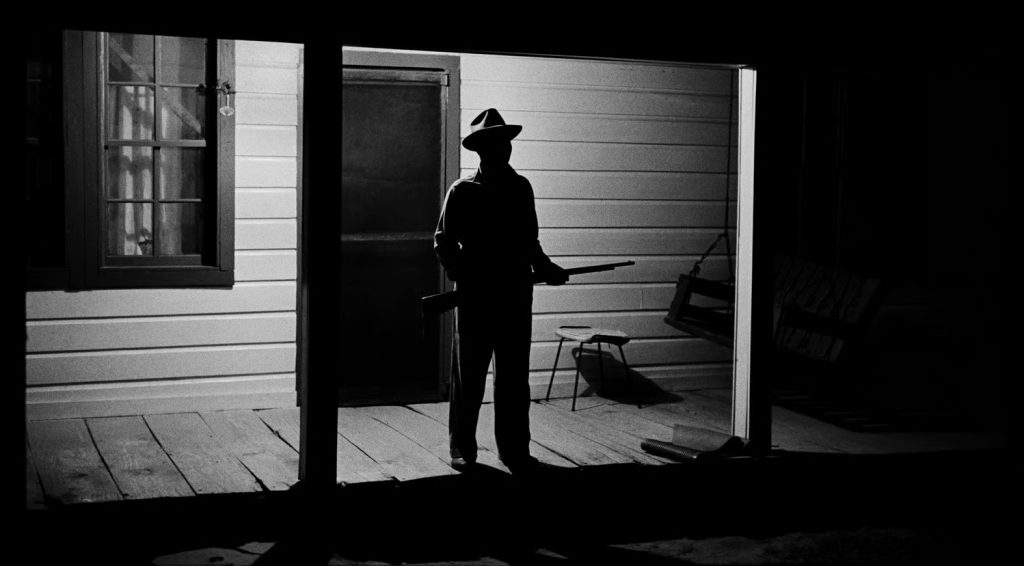
Rev. Joseph Carter stands guard on his front porch amid threats of Klan violence after he registered to vote, 1964.
Photo: Bob Adelman
The Double Vision
What those summers gave you, accumulated over years, was something no single place could provide alone: to carry two versions of America in your body at once, to feel them both as true as weather.
Denver had been the destination – the city your family had traveled toward, that your father had chosen to stay in after the war offered him the choice. It was a city with its own hypocrisies and its own segregations, its redlined neighborhoods and its sunburned racism that imagined itself more polite than the Southern kind because it didn’t put its name on signs. But Denver could also produce in a Black child a certain softening at the edges, a sense that the worst of the American story had been left somewhere behind and south. Brownsville corrected that every summer, without ever speaking directly about it.
The screen door slapping behind you. The grandfather lifting the wet burlap. The cousins gone before sunrise and back before the worst heat. The jukebox bleeding out through Cooper’s walls into the warm evening. None of these were small things dressed up to look small. They were the substance of a life built with intention and defended with stubbornness across generations inside a social order that had devoted enormous energy to preventing it from existing at all.
That it was also genuinely joyful – loudly, physically, extravagantly joyful in the way only a childhood summer among people who love you can be – was because of all of it.