

Relationships Strong Enough to Solve Problems
Roger LevyThe May Institute Faculty Meeting traditionally mixes business and pleasure. This May, our business included a report on our annual elections for faculty governance by Chair of the Committee on Nominations (CoN) and former Chair of the Faculty Rick Danheiser. The faculty have elected the next Chair of the Faculty for the 2027–2029 term: W. Craig Carter, Toyota Professor in Materials Processing and Professor of Materials Science and Engineering. Professor Carter will serve as Chair-Elect in 2026–2027, during which time he will serve on the Faculty Policy Committee and join the Faculty Officers Group, alongside me, Associate Chairs of the Faculty Bevin Engelward and Erica James, and Faculty Governance Administrator Tami Kaplan. The faculty also approved CoN’s slate of 32 nominees to fill open positions on the Standing and Special Committees of the Faculty. Professor Carter and all incoming and outgoing committee members have my sincere gratitude.
During the May meeting, the faculty also approved the new Evening MBA program proposed in April by Professors Antoinette Schoar and Rodrigo Verdi. The Editorial Board of the MIT Faculty Newsletter, now chaired by Professor Franz Ulm, presented its inaugural annual report to the faculty, and Executive Vice President and Treasurer Glen Shor provided a brief overview of campus security cameras. Details of these presentations and ensuing discussions will be available in the minutes of the May meeting, which will be presented for approval at the September 2026 Institute Faculty Meeting.
The first item purely in the category of pleasure is the Report of the Killian Award Selection Committee. The Killian Award is the highest honor bestowed by the MIT faculty on a colleague. This year’s award, presented by committee chair Professor Xuanhe Zhao, went to Professor Elazer Edelman, recognizing his exceptional contributions to medical engineering and science, to MIT, and to the world. Professor Edelman will deliver the Killian Lecture in the upcoming academic year.
The second is the honoring of our faculty colleagues who are releasing their tenure lines to move to the rank of Professor Emerita/us or of Professor, Post-Tenure. This year, 26 of our colleagues are transitioning to these ranks; collectively, they have contributed over 1,130 years of service as members of the MIT faculty. At the May meeting, for each such faculty member the Chair of the Faculty reads a brief citation highlighting their achievements and contributions. Reading the citations for our colleagues was one of the true highlights of the year for me.
These traditions at the May meeting remind us that being a member of the MIT faculty is not just a job, not just a career, not even just a vocation: it is also membership in a remarkable community. When I joined the faculty just over 10 years ago, I was unexpectedly struck by the character and strength of the Institute community. In my experience, what is truly special about MIT is not only that it nurtures and celebrates excellence, for which it is globally famous, but also its commitment to a supportive and caring environment, which is not necessarily well known.
With that gratitude in mind, I will use the remainder of this column to sound a cautionary note on our state of community, specifically regarding what I will call the strength of our social fabric. Over the course of the year, I have heard many remarks in different contexts to the effect that we are not as strongly connected to one another here at MIT as we once were, and as we should be. Two obvious reference points are the long period we spent largely remote due to the COVID pandemic, and the campus-internal tensions following October 7. Nonetheless, refrains that the past was better than the present are perennial, and not all can be trusted. The evidence I have available thus far is a combination of anecdotal reports and fragmentary local and global quantitative data. So my remarks and claims should be taken as tentative and speculative. But my judgment after a year’s service as Chair of the Faculty is that there is sufficient cause for some concern.
As I wrote in my previous column, the Chair of the Faculty is an ex officio member of the Corporation Joint Advisory Committee on Institute-Wide Affairs (CJAC). CJAC is project-based, and one of our main projects for the year was to study ways to improve the campus climate with respect to civil discourse. The main activity for the subcommittee taking on this project (which I was on) was facilitating a series of informal conversations over meals between groups of Corporation members and undergraduate or graduate students (sometimes including a faculty member), loosely modeled on the random faculty–Corporation member discussions initiated in 2021, which in turn were modeled on the random faculty gatherings hosted by the faculty officers. These informal conversations seem to have been informative and well-received for all parties. At the final meeting of the subcommittee, our conversation returned to the broader topic of the social fabric of the Institute, and Professor Cullen Buie, one of CJAC’s faculty members, made an arresting remark: that “we want relationships that are strong enough to solve problems.” This framing is potentially very powerful because it is simultaneously general enough to encompass the range and diversity of relationships within our community, concrete enough — at least in principle — for benchmarking (one can imagine sitting down and listing the relationships), and aligned to the goal of achieving purposeful work together. The question then arises: to what extent are the conditions at MIT conducive to the development of relationships this strong?
As a cognitive scientist of language, much of my research involves studying communication; as an MIT faculty member, nearly all my professional work takes place in collaboration. This knowledge and experience informs a common-sense but crucial point about how we interact with each other. As a general rule, the richer the communicative channel and the deeper the shared context, the better things go. Phone is better than text, a video call is better than phone, and in person is best of all. This idea is supported in fields ranging from psycholinguistics (Clark & Brennan, 1991) to organizational behavior (Daft & Lengel, 1986) to social psychology (Drolet & Morris, 2000). It also aligns with observations by accomplished academics. A recent comment from our own Randall Davis: “a two minute phone call is worth a dozen emails.” A lengthier remark by the legendary computer scientist Richard Hamming attributes long-term research impact to making oneself available for in-person interactions with colleagues:
. . . if you have the door to your office closed, you get more work done today and tomorrow, and you are more productive than most. But 10 years later somehow you don’t quite know what problems are worth working on; all the hard work you do is sort of tangential in importance. He who works with the door open gets all kinds of interruptions, but he also occasionally gets clues as to what the world is and what might be important.
Investigating similar ideas, Drolet & Morris asked “whether, in a cooperative climate, negotiators’ visual access to each other’s nonverbal behavior fosters a dyadic state of rapport that facilitates mutual cooperation,” and obtained affirmative findings as measured by quantitative joint gains in experimentally controlled negotiation settings.
Putting these pieces together: we want relationships strong enough to solve problems, and in-person interactions are unmatched for developing and using these relationships. How is this going for us today at the Institute? I have heard a number of remarks to the effect that colleagues simply aren’t around as much as they were, say, a decade ago. Another acute observation by a highly respected colleague: the strengthening and professionalization of student support at MIT over recent decades has brought important benefits to students, but has also come at the cost of a narrowing of the typical range of faculty–student interactions and a resulting weakening of the bonds between us and our students.
Buttressing these anecdotal observations with quantitative data would be ideal; the evidence is fragmentary but still worth sharing. Starting in 2022, our Quality of Life survey has included a number of questions regarding how much community members work on campus or on site, and how much remotely. Analysis of responses by faculty (Figure 1) indicates that even after our formal return to campus in fall 2021, it has taken us years to return to a steady-state on-campus presence (if indeed we have reached a steady state). These data also indicate that tenured faculty survey respondents spend about half a day less on campus than tenure-track (i.e., pre-tenure) faculty survey respondents.
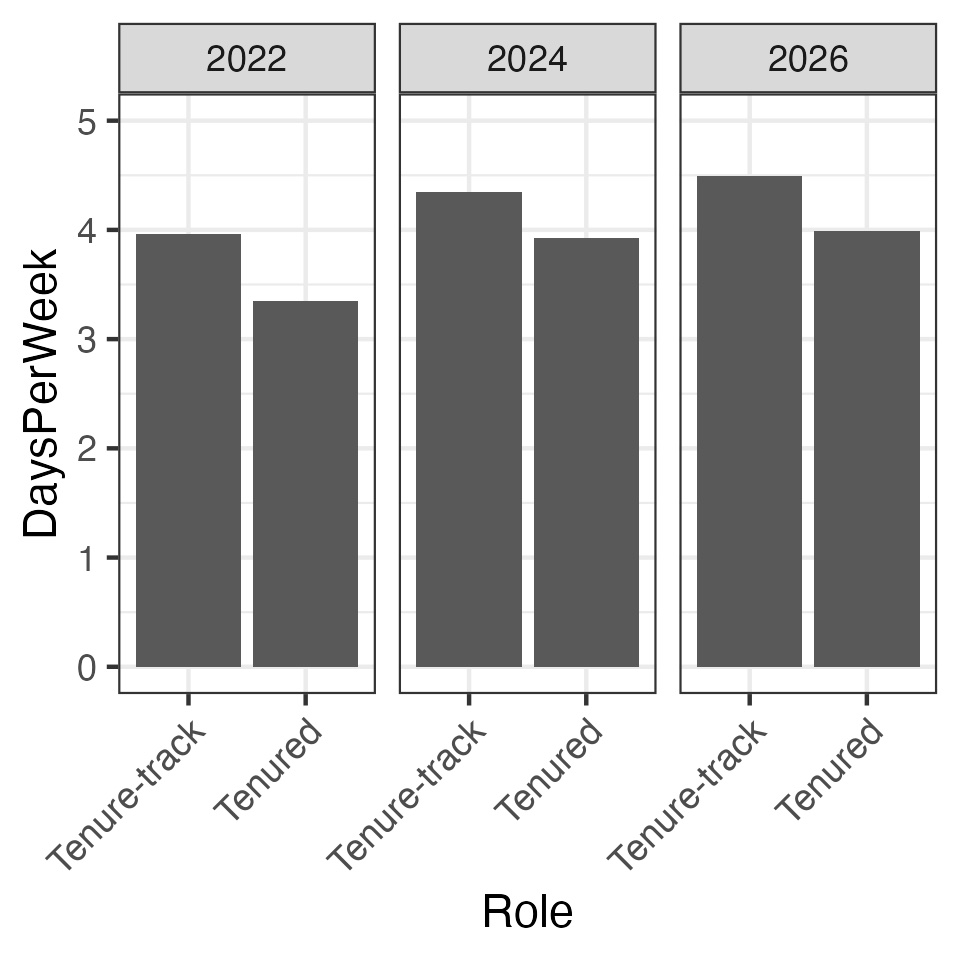
Figure 1: Average days/week working on campus among Quality of Life survey respondents
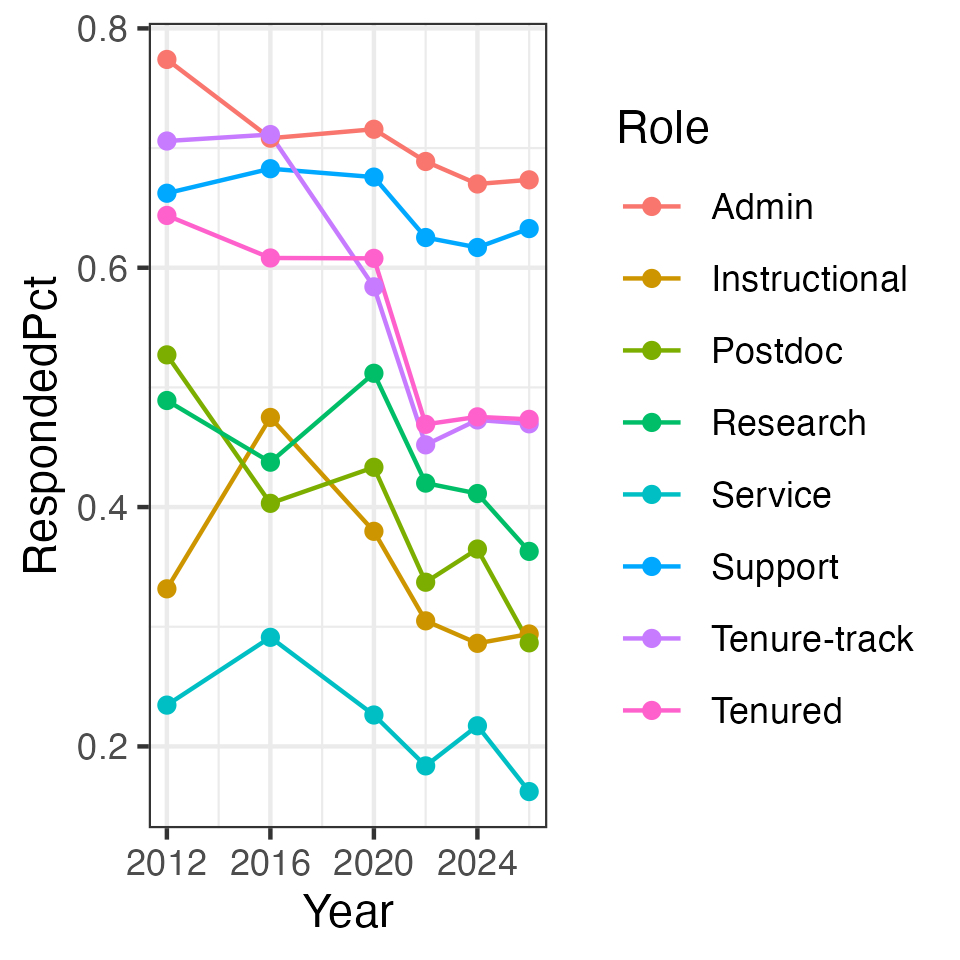
Figure 2: Response rate to Quality of Life survey, by role
Perhaps more striking is the trend in response rate to the Quality of Life survey itself (Figure 2). Across most roles we see signs of a downward trend across the last 14 years, but this pattern is most pronounced for faculty: post-COVID our response rate is at least 12% lower than before COVID.[1] There could well be a positive correlation between time spent on campus and proclivity to respond to the Quality of Life survey, in which case extrapolating the days per week rates in Figure 1 to the entire faculty would overestimate our on-campus presence. Overall, these data raise concerns of a retreat from campus life by some of our faculty.
One last source of quantitative data is global. In many fields it is theoretically and empirically important to know how much we talk to each other. Pfeifer and Mehl (2026) note that in exploratory analysis based on a large-scale registered replication of a landmark study (Mehl et al., 2007) using conversations passively sampled by on-body electronically activated recorders between 2005 and 2019, Tidwell et al. (2025) estimated a year-over-year decline of about 300 words spoken per day during this period – a decline of over 2% per year, totaling about 33% during the course of the study. On my reading, this result should be taken as tentative but potentially remarkable: at a rate imperceptibly slow yet dramatically fast in terms of social change, talking to each other is becoming less and less a part of our social relationships. Additionally, social relationships are part of networks, and network effects can be nonlinear, offering further reason for caution.
We are about to enter the summer, a period where we faculty traditionally take time for focused research work, time with family, travel, or other pastimes. I’ll close by suggesting that this year, we also use the time to think about the professional and social contexts and relationships that we will return to come September, and how we might reinvest in strengthening them. Enjoy the upcoming months, and see you in the fall.
References
Clark, H. H., & Brennan, S. E. (1991). Grounding in communication. In L. B. Resnick, J. M. Levine, & S. D. Teasley (Eds.), Perspectives on socially shared cognition (pp. 127–149). American Psychological Association.
Daft, R. L., & Lengel, R. H. (1986). Organizational information requirements, media richness and structural design. Management Science, 32 (5), 554–571.
Drolet, A. L., & Morris, M. W. (2000). Rapport in conflict resolution: Accounting for how face-to-face contact fosters mutual cooperation in mixed-motive conflicts. Journal of Experimental Social Psychology, 36 (1), 26–
50.
Mehl, M. R., Vazire, S., Ramírez-Esparza, N., Slatcher, R. B., & Pennebaker, J. W. (2007). Are women really more talkative than men? Science, 317 (5834), 82.
Pfeifer, V. A., & Mehl, M. R. (2026). Sliding into silence? We are speaking 300 daily words fewer every year. Perspectives on Psychological Science.
Tidwell, C. A., Danvers, A. F., Pfeifer, V. A., Abel, D. B., Alisic, E., Beer, A., Bierstetel, S. J., Bollich-Ziegler, K. L., Bruni, M., Calabrese, W. R., et al. (2025). Are women really (not) more talkative than men? A registered report of binary gender similarities/differences in daily word use. Journal of Personality and Social Psychology, 128 (2), 367–391.
[1] I am grateful to Jon Schwarz and Gregory Harris of Institutional Research for helping me analyze and interpret these Quality of Life survey results, including the breakdown between tenured and tenure-track faculty. For Figure 1, I have treated the response category “5+ days per week” as 5 days per week. Note that the 2020 survey closed on March 11, the day after MIT’s first major public response to COVID, and so is best understood as an effectively pre-COVID survey.