

About five miles north of the Moscow Kremlin is an immense monument to Soviet Russia’s idealized image of itself. The Exhibition of Achievements of National Economy – known colloquially by its Russian acronym VDNKh – is a cross between Disney’s Epcot Center and the Smithsonian. Inaugurated in 1939, it is a patriotic theme park that now covers an area 30 times bigger than Red Square and contains over 80 pavilions devoted to the manifold cultures of the Soviet Union and the scientific and industrial accomplishments of its people. A glittering main drag features expositions from each of the once-united republics, from Armenia to Uzbekistan. The Museum of Cosmonautics is nearby, housing Soyuz rockets, replicas of the Sputnik satellites, and Yuri Gagarin’s space capsule. Hovering over it is one of the most famous works of Soviet art, Vera Mukhina’s Worker and Kolkhoz Woman, a colossal steel sculpture of a young couple striding forward to forge a socialist future that is now solidly in the past.
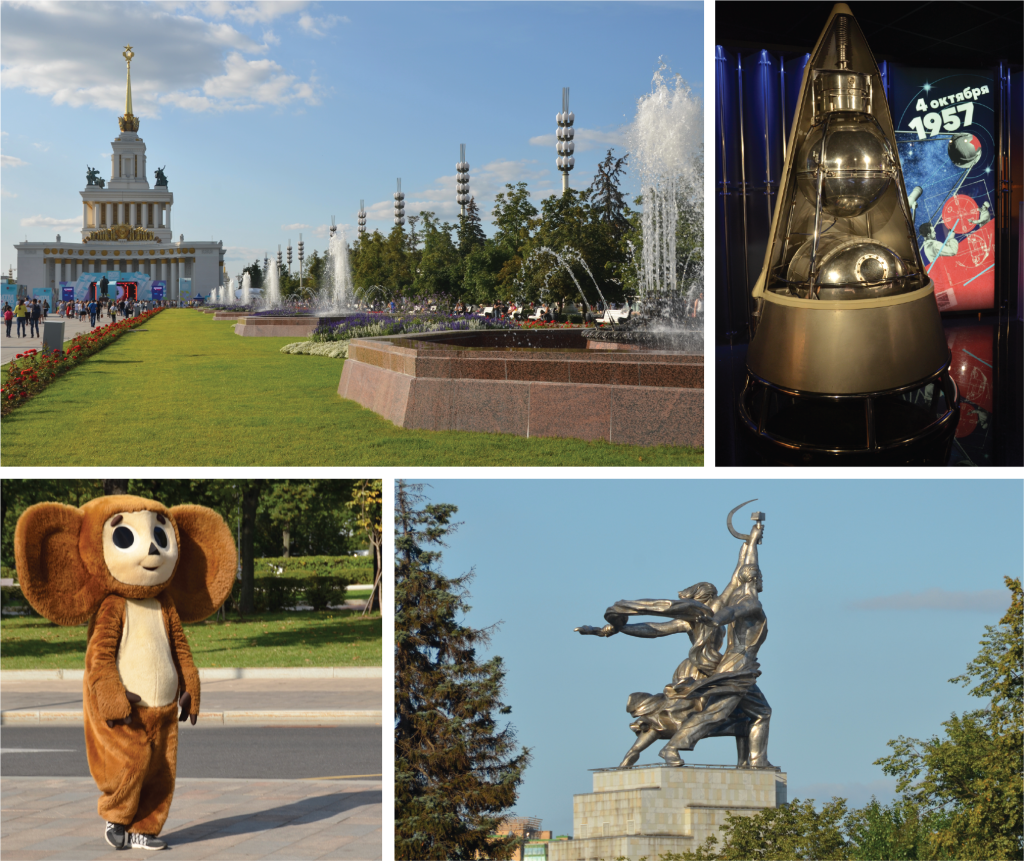
For my family, a visit to VDNKh in the summer of 2019 was also a reconnection with our own past. My wife grew up in Moscow, but she had rarely returned since her family emigrated, decades ago, to escape the systemic antisemitism that stunted opportunities for them in the Soviet Union. My daughter was raised among Russian-speaking relatives, with Russian songs and stories woven throughout her upbringing in Boston; but until our trip that year, she had yet to experience her motherland in person. For my wife and daughter, the park offered material realizations of mundane childhood memories: a frolicking cosplayer enacting the beloved cartoon character Cheburashka, the cuddly stuffed space dogs Belka and Strelka (successors to Sputnik’s Laika), and an endless supply of fried donuts, called ponchiki, that were once only special treats. For me, however, the most fascinating aspect of this place was its Soviet-accented glorification of values that I think of as quintessentially American, and indeed exemplified by our community at MIT: an optimistic worldview, strength through diversity, and technological leadership.
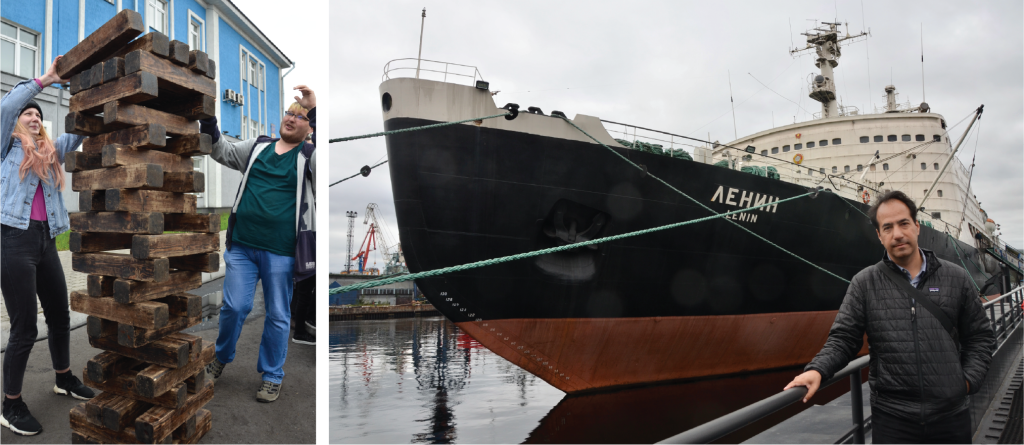
Our trip that summer later took us up the great sweep of European Russia to Murmansk, the world’s largest city above the Arctic Circle. Murmansk has an entirely different feel from modern Moscow. It lacks the fresh paint and post-communist commercialism of the capital. The center is filled with the blocky and impersonal postwar buildings called Khrushchevkas, many in states of decay. Posters at the bus stops urge citizens to be in a good mood, and the most prominent monument here is a grim 116-foot soldier who stands eternal guard over a battlefield where 7,000 Soviet troops died fighting off the Nazi invasion. But even this gray city finds colorful ways to celebrate its achievements. Pride of place in Murmansk harbor goes to the icebreaker Lenin, the world’s first nuclear-powered surface vessel and now a museum ship. From 1959 to 1989, this 16-kiloton leviathan cut cargo lanes through the frozen waters north of Russia. She was a revolutionary feat of engineering, honored by her revolutionary name. On the day we toured the Lenin, there was a lively science fair being held on the dock nearby. We paused longest at a jenga tower where some of the locals were enjoying principles of Newtonian mechanics.
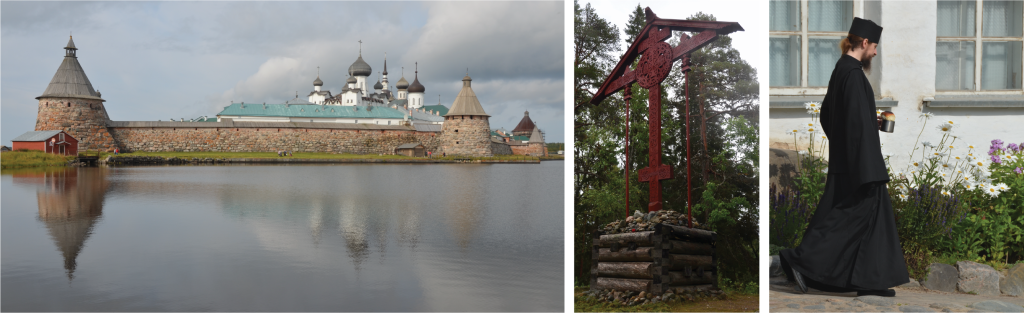
Although Murmansk was fascinating, we had come there not for its own sake, but as the starting point for a journey back down south. We boarded an overnight train to Kem, a dilapidated provincial town on the coast of the White Sea, from which we caught a ferry out to the Solovetsky islands. They are the site of a storied 15th-century monastery that served as the first Soviet state prison camp – the “mother of the Gulag,” as the writer Aleksander Sozhenitsyn dubbed it. After the Russian Civil War, the monks were cleared out and their cells packed instead with inmates. In its early years, the facility served as a base for excavating the nearby White Sea Canal, a vast engineering effort estimated to have cost the lives of 25,000 forced laborers. Later, at the height of Stalin’s purges in the 30s, the islands and surrounding areas were used for mass executions of ethnic minorities and dissidents, including scientists and other intellectuals. When we visited, killing sites were marked by shadowy wooden crosses set amongst the pines. The monastery itself was nothing short of majestic, however. Its stone turrets and tiled onion domes, brightly lit by fickle bursts of sunlight, were reflected lucidly in the surrounding littoral pools. In the time since the fall of communism, a tide of spirituality had washed back in. Both pilgrims and priests were there, breaking bread in the canteen and burning incense in the chapels.
It seems beyond contradictory that the slaughter at Solovetsky peaked just as the breadth of Soviet ingenuity and culture were being valorized by construction of the VDNKh exposition. In Moscow, as in Murmansk, the USSR publicly exalted innovation, industry, and popular unity, while behind the scenes, the regime undercut these very values by persecuting the intelligentsia and marginalized groups who shared their country. The cognitive dissonance between the state’s rhetoric and actions seems in keeping with Winston Churchill’s famous characterization of Russia as “a riddle, wrapped in a mystery, inside an enigma.” And as an American in 2026, it is hard to recall these experiences without the sense that the historic riddle of contradictions is now being retold, at least softly, here at home.
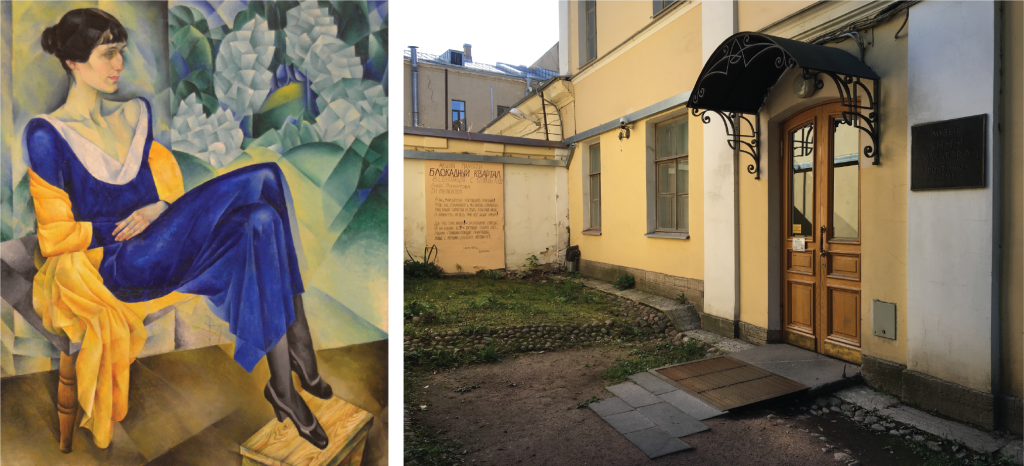
On the last day of our 2019 trip, we found ourselves in the St. Petersburg home of Anna Akhmatova, the acclaimed poet whose work bears haunting witness to the tribulations of the twentieth century. Seeing Russia for myself had helped me appreciate the significance of her words to ex-Soviets like my wife, who carry the intergenerational legacy of those times inside them. Akhmatova lived through the First World War, the Revolution, the Great Terror, and the Siege of Leningrad. Her first husband was shot by the Soviet secret police in 1921 and her son was interned for almost 20 years in the gulags, an agony that evoked some of her most moving writing. Despite these punishments, however, Akhmatova remained in her spare apartment on the Fontanka Embankment, determined to stand her ground through the bleakest moments. “No foreign sky protected me,” she wrote, “no stranger’s wing shielded my face.” Akhmatova’s fortitude can inspire us, too, to stand our ground in the face of challenges we face at present – and in defense of ideals we truly believe in. There would be no riddle in that.
Photography: Alan Jasanoff and Luba Katz