

The Temptations and Risks Posed to Multilingual Communicators Posed By Generative AI
Eric Grunwald“Writing and thinking and learning are the same process.” —William Zinsser
In the May/June 2024 edition of the FNL, I reported on two pieces of 2023 research showing the communicative disadvantages still faced by non-native-English-speaking (NNES) graduate students. First, Amano, et al., had found that it still took early-career NNES scholars on average 50% longer to read an academic journal article and 50% longer to write one, and that uptake to journals was tangibly lower for NNESs due to language issues. Their difficulties in speaking in academic contexts were just as concerning.
The other piece of research – the 2023 MIT Graduate Communication Survey, conducted by my colleague Dr. Elena Kallestinova, director of MIT’s Writing and Communication Center, and myself – showed almost exactly the same disadvantages. Almost across the board, NNES students at MIT reported difficulties in communicative task at a rate about 50% greater than those of native-English-speaking (NES) students.
I thus called for departments and advisors to support NNES graduate students by affording them the encouragement, time, and curricular space to take the English Language Studies (ELS) classes recommended to them based on their results on the English Evaluation Test (EET) so that these students could perform at MIT to the best of their abilities and compete on a level playing field. This call was made in response to ELS enrollments, particularly in writing, not bouncing back following the Covid-19 Pandemic. And the following semester, fall 2024, ELS classes were all but full again (and while the evidence for causation is circumstantial, no other factors explain it).
Now, though, two years later, writing enrollments have dropped again, and even further. This despite continued high subject evaluations (averaging above 6.7/7.0), and despite steady numbers of recommendations based on the EET. For example, for 21W.219, “Foundations of Academic and Professional Writing,” the high-intermediate foundational class designed for first-year students who show significant gaps in the writing skills they need upon arrival at MIT:
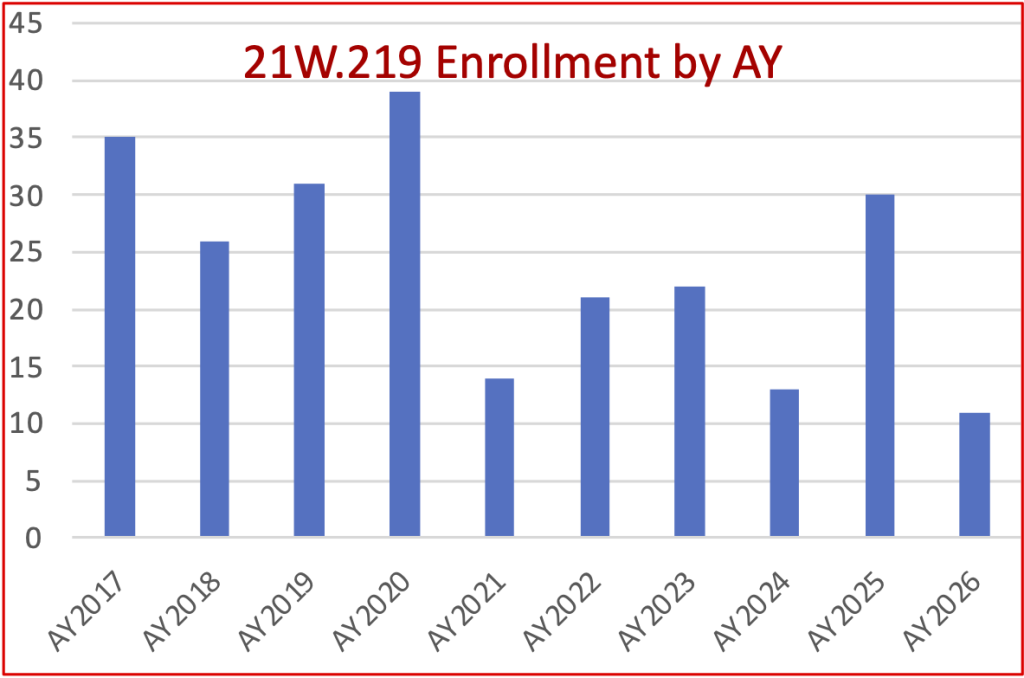
While taking this course was recommended to over 40 students last August, only five of those have taken one of the four sections we have offered. (The other six students who have taken it are either from other years or from Harvard.)
Again, the evidence is circumstantial, but the only factor that seems to have changed since 2023 is the advent and spread of generative AI. That is, because they have less confidence in their English grammar, vocabulary, and academic style than native speakers, the temptation is greater for NNESs to have AI write or “fix” their texts for them. Thus, it seems these students are either choosing not to take their recommended classes or are not being encouraged to or required to by their departments or advisors.
Unfortunately, the costs for NNESs are also greater than for NESs: they do not learn many of the basics that would make them less dependent on AI and would let them express their own ideas clearly and accurately in their own voices.
Recent research bears this out: Wang (2024) discovered “two dilemmas encountered by [L2] students in their generative AI-assisted writing: (1) the challenging balance between incorporating AI to enhance writing and maintaining their authentic voice, and (2) the dilemma of weighing the potential loss of learning experiences against the emergence of new learning opportunities accompanying AI integration.”
More recently, a 2025 study by Hwang, et al., employed four datasets and three kinds of analysis to corroborate such previous studies as Wang’s and ultimately points to “the potential of generative AI to support [L2] writing processes while also providing a tailored learning environment that caters to individualized learning experiences” (12).
However, Hwang, et al., “also exposes several concerns,” such as L2 writers’ own worries about “unhealthy reliance on generative AI, which can hinder their development….” As one interviewee in the study said, “[B]ecause of the technology, I become lazy and do not want to use my brain” (9-10). Ultimately, the study “underscores the need to educate the students about digital literacy and the ethical implications of using AI” and “empower[ing] L2 learners to make use of AI in a way that is both effective and ethical” (12).
Thus, the choice is not between using AI and taking ELS classes. The choice, as we’re all finding, is whether to help students use AI to effectively learn and empower themselves, i.e., intentionally and strategically, rather than just letting or pushing students to use it as a replacement for thinking and learning. Thus, we in ELS are working hard to develop and incorporate AI-aware pedagogy into our classes.
The stakes of such choices are higher now, though, especially for NNESs. Before AI, if a student did not take a class, they could still learn something through immersion and by hammering through the processes of reading and writing documents themselves (and maybe getting extensive corrections from their advisors or colleagues). They were still at least cognitively engaged in “Writing an extended text at an advanced level,” which “involves not just the language system [but rather] poses significant challenges to our cognitive systems for memory and thinking as well,” as Kellogg wrote in 2008 (“Training Writing Skills: A Cognitive Developmental Perspective”).
But while struggling with those tasks, combined with their constant listening and reading, would improve their skills somewhat, they would remain unaware of persistent patterns of problems in their speech and written texts and, perhaps worse, would continually doubt whether they were expressing complex ideas clearly and accurately.
Kellogg went on, “Indeed, writers can put to use virtually everything they have learned and stored away in long-term memory. But they can only do so if their knowledge is accessible, either by rapidly retrieving it from long-term memory or by actively maintaining it in short-term working memory. Thinking is so closely linked to writing, at least in mature adults, that the two are practically twins. Individuals who write well are seen as substantive thinkers. . . . Learning how to compose an effective extended text, therefore, should be conceived as a task similar to acquiring expertise in related culturally acquired domains.”
Offloading to AI the work of generating text, though, or even revising and proofreading, provides little to none of the “developmental struggle” that all learning requires. So now if a student doesn’t take a class, they’re not going to develop their own language skills much regardless. As a student in a different study (Wang & Luo, 2026) reports, “If I always rely on AI, I cannot really get to grips with [learning vocabulary]!”
One response to our 2023 graduate survey that I neglected to mention in my 2024 piece was that from students who had been recommended for an ELS course but hadn’t taken one yet: What would make it more likely that they would?, we asked. Over 80% of NNESs taking the survey responded, “If my department would promote ELS classes more.”
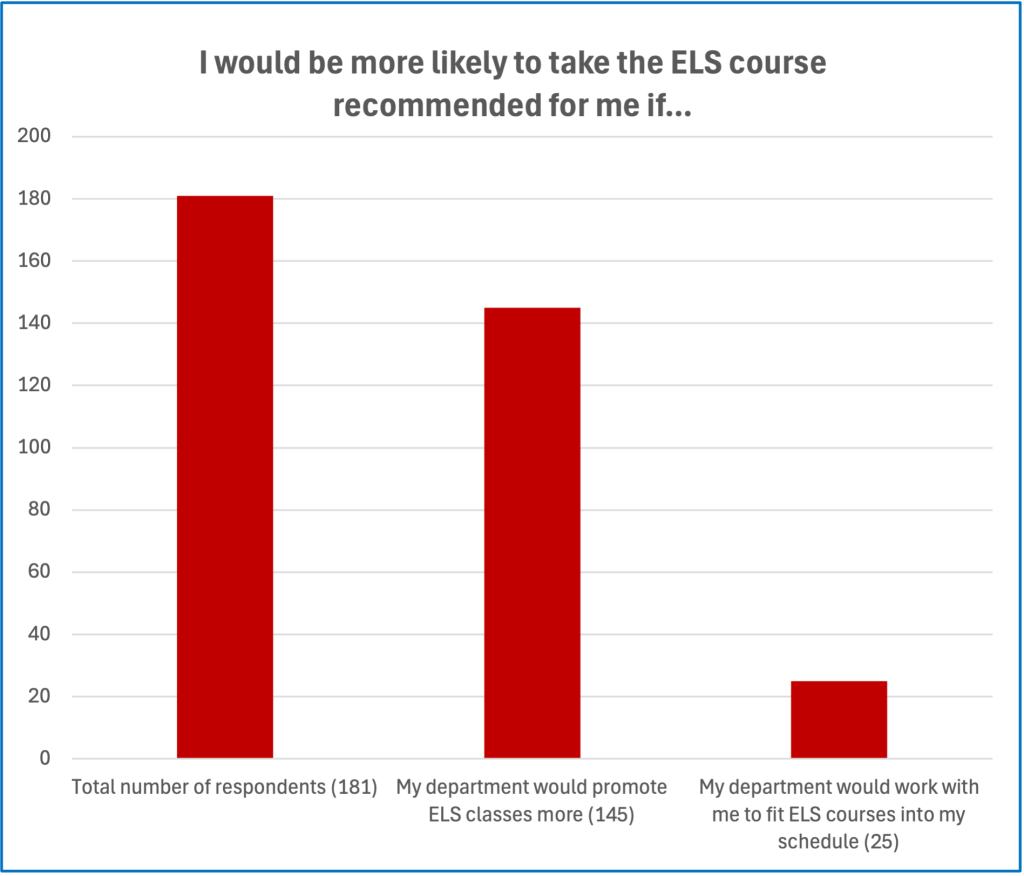
Thus, I again ask departments and faculty to ensure that international graduate students have the time and motivation to avail themselves of the support and training we offer. Now, most institutions that give graduate students an English placement exam after admissions do in fact require the recommended courses to be taken, and that would be one way to ensure that MIT students develop the skills they need. Obviously there are problems with that approach: It reduces student autonomy and departmental autonomy, raises issues of fairness in terms of course load, and so on. On the other hand, elective credit might be given for ELS courses, and perhaps other compensations exist.
Perhaps, though, there is a sustainable middle ground, and I raise these issues in the hope of further exploration of that ground.
In that vein, ELS is also undertaking initiatives to keep information and dialogue flowing. I have begun forming, for one, an ELS Advisory Council composed of faculty from across the Institute to meet semi-regularly so that I hear faculty’s perspectives and even advice regularly. I have four professors on board already, but if you’re interested in being a part of it, please email me.
Finally, I encourage all of us to think about how we listen to and interact individually with NNES students in discussing their communication tasks and their use of AI and to engage them dialogically about it, such as asking how they think it helps or harms them but also helping them see the profound benefits to them of their possessing their own robust communication skills in English.
Ultimately, if you’ve ever lived in a country or even visited one where you don’t know the language well enough to converse at normal speed but must navigate situations ranging from ordering food and finding housing to registering administratively for something, understanding lectures, or even dealing with legalities, then you know the somewhat liminal spaces that immigrants operate in and the difficulty native speakers can have in quite understanding the challenges you face.
Ultimately, at this “inflection point” in which now we find ourselves, including the urgent financial and political challenges and the loud debates we now face, it is important that we not “cognitively offload” the needs and concerns of our less voluble students.
References:
Grunwald, Eric. “Non-Native English-Speaking Graduate Students Still Face Significant Disadvantages.” MIT Faculty Newsletter, 11 May 2024, https://fnl.mit.edu/may-june-2024/non-native-english-speaking-graduate-students-still-face-significant-disadvantages/.
Hwang, Haerim, et al. “Generative AI Is Useful for Second Language Writing, but When, Why, and for How Long Do Learners Use It?” Journal of Second Language Writing, Vol. 69, Sept. 2025, p. 101230. ScienceDirect, https://doi.org/10.1016/j.jslw.2025.101230.
Wang, Chaoran. “Exploring Students’ Generative AI-Assisted Writing Processes: Perceptions and Experiences from Native and Nonnative English Speakers.” Technology, Knowledge and Learning, Vol. 30, no. 3, Sept. 2025, pp. 1825–46. Springer Link, https://doi.org/10.1007/s10758-024-09744-3.
Wang, Yingqi, and Xiaohang Luo. “Generative AI as Cognitive Co-Participant: Disciplinary Modulation of EFL Academic Reading Load and Motivation.” Google Docs, AAAI, 2026, https://drive.google.com/file/d/1lRXp8vSSSdNlT-XhVy_Ysc8wwieVdDpb/view?usp=drive_link&usp=embed_facebook.